
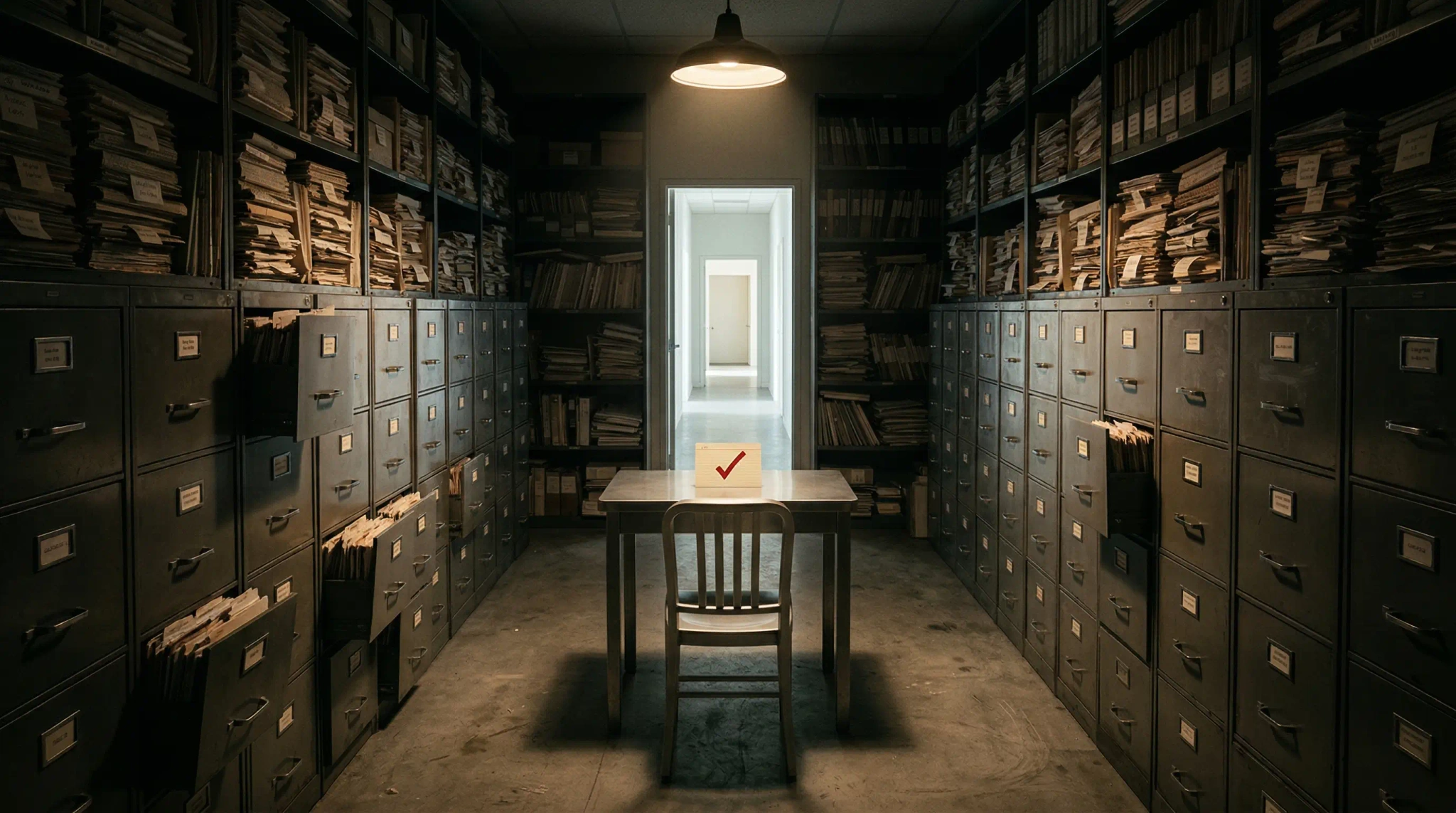
The Research Trap: Why More Information Won't Help You Decide
Analysis paralysis affects 85% of business leaders. Here's why gathering more data makes decisions harder — and how to break the cycle.
You've been researching for three hours. Seventeen browser tabs are open. You've read reviews, compared specs, watched explainer videos, and asked for advice in three different group chats.
And somehow, you're less ready to decide than when you started.
This is the research trap — and it's more common than you think. A recent survey found that 85% of business leaders experienced "decision distress" in the past year, regretting choices or questioning their judgment after the fact. The problem isn't a lack of information. It's that we believe more research will lead to clarity, when often it leads to the opposite.
The Paradox of the Modern Researcher
We live in an age of infinite information. Any question can be answered in seconds. Any product has hundreds of reviews. Any topic has decades of expert analysis available for free.
This should make decisions easier. It doesn't.
Barry Schwartz's research on the "paradox of choice" showed that having more options doesn't make people happier — it makes them less satisfied, more anxious, and more likely to defer decisions entirely. The sweet spot for decision quality is around three to five options. Beyond that, comparison becomes noise.
The same principle applies to information. After a certain point, additional research doesn't improve decision quality — it degrades it. You start finding contradictory evidence. You discover edge cases that seem important but aren't. You give equal weight to a carefully reasoned article and a random forum comment from 2017.
The Real Cost of Analysis Paralysis
Here's what the research says about how we actually spend our time:
- 79 days: Average time spent on major purchase decisions (cars, appliances, electronics)
- 1 hour 32 minutes: Time spent daily on routine decisions (meals, clothing, scheduling)
- 24% of consumers: Spend up to six months researching expensive purchases
- 56 touchpoints: Average number of interactions before a final purchase
That last number is worth pausing on. Fifty-six touchpoints. Not because the 57th will reveal the truth, but because we keep hoping the next piece of information will make the decision obvious.
It rarely does.
Why Your Brain Gets Stuck
Analysis paralysis isn't laziness. It's not indecision. It's your brain doing exactly what it thinks you're asking for: more analysis, indefinitely.
Neuroscience research by Shenhav and Buckner at Harvard showed that decision difficulty activates the anterior cingulate cortex, which signals cognitive conflict. The more options you consider, the stronger that conflict signal becomes — and the more your brain resists committing to any single path.
Your prefrontal cortex, responsible for weighing trade-offs and projecting outcomes, has finite processing capacity. When you feed it unlimited variables, it doesn't produce a better answer. It produces no answer.
Psychologist Gerd Gigerenzer's work at the Max Planck Institute found that simple heuristics — quick rules of thumb — often outperform complex analysis, especially in uncertain environments. His research on "fast and frugal" decision-making showed that ignoring most available information frequently leads to better outcomes than weighing all of it.
The Hidden Fear
Analysis paralysis usually has a fear underneath it. Name it, and you can address it.
Common fears that drive endless research:
- "I'm afraid of making the wrong choice and regretting it"
- "I'm afraid of looking stupid to colleagues or friends"
- "I'm afraid this decision is permanent and I can't undo it"
- "I'm afraid I haven't considered every angle"
Here's the uncomfortable truth: research by de Martino et al., published in Science, found that people experience more regret from inaction than from action — especially over time. In the short term, bad decisions sting. In the long term, unmade decisions haunt.
The thing you're most afraid of — wasted time, missed opportunity, regret — is exactly what freezing creates.
Six Strategies That Actually Work
1. Set a hard deadline
Not "I'll figure it out soon." A specific date and time: "I will decide by Friday at 5 p.m."
Research by Ariely and Wertenbroch confirmed that self-imposed deadlines significantly improve task completion — even when arbitrary. Without a deadline, your brain treats the decision as a puzzle with infinite time, which means infinite analysis.
2. Shrink your options to three
If you're choosing between seven software tools, four job candidates, or twelve vacation destinations, you're working with too much. Force-rank to your top three. Eliminate everything else.
The elimination feels painful because you're "losing options." But those options were never real — they were noise preventing you from engaging deeply with any single path.
3. Define "good enough" before you start
Perfectionism fuels paralysis. If the only acceptable outcome is the optimal choice, you'll never have enough information to be sure.
Instead, define your minimum requirements before comparing. What three things must be true for this to be good enough? Write them down. If an option meets all three, it qualifies. Stop comparing qualified options — that's where the loop restarts.
Schwartz's research distinguishes between "maximizers" (who need the best) and "satisficers" (who need good enough). Satisficers consistently report higher life satisfaction and less decision regret.
4. Ask what you'd tell a friend
When someone describes a decision they're stuck on, you almost always see the answer faster than they do. Not because you're smarter — because you're not emotionally entangled.
Use that distance on yourself. Describe the decision as if a friend were facing it. The advice you'd give a friend is usually the advice you need to take.
5. Run the smallest possible test
When you can't decide between two paths, stop comparing and start testing. Take the smallest possible step on the option you're leaning toward and see what happens.
Considering a career change? Don't quit your job or enroll in a degree. Have one coffee conversation with someone in the field. Thinking about moving? Spend a weekend there before signing a lease.
Small tests generate information that analysis can't. Ten minutes of testing beats ten hours of deliberation.
6. Use a decision journal
Write down how you made a choice: what you considered, what you decided, and why. Weeks or months later, review it.
What you'll find: most of your "agonizing" decisions turned out fine. The evidence accumulates that you are a better decision-maker than your anxiety suggests. This practice is used by professional investors and military strategists — and it works for personal decisions too.
When Research Helps vs. When It Hurts
Research helps when:
- You're making a genuinely complex decision with high stakes
- You need to understand a domain you know nothing about
- You're trying to avoid a specific, known pitfall
Research hurts when:
- You're collecting information to postpone committing
- You've already gathered enough to decide but keep searching for "certainty"
- You're comparing options that all meet your criteria
The best decision-makers aren't information hoarders — they're pattern matchers. They build understanding when there's no pressure, focus on what matters, and know their lane.
The 40-70 Rule
Colin Powell had a practical guideline: Act when you have 40% to 70% of the necessary information. Less may lead to errors. More often means missed opportunities.
"Do not sacrifice quality for speed," he said, "nor action for certainty."
This is particularly relevant now. The pace of change in most industries means that waiting for perfect information often means the decision becomes irrelevant before you make it.
Breaking the Cycle
Here's the pattern: you feel uncertain, so you research. More information creates more variables to weigh, which increases uncertainty, which triggers more research. It's a self-reinforcing loop.
The way out isn't another article. It's a decision.
Not a reckless one. Not uninformed. But made with enough information — and the recognition that clarity comes from contact with reality, not from more thinking about reality.
The goal isn't to know everything. It's to know what matters — and then act.
Rabbit Hole helps you research smarter, not longer. Instead of opening twenty tabs and hoping you'll find the signal in the noise, Rabbit Hole conducts deep, structured research and brings back what actually matters — so you can decide and move on.
Related Articles
The 2026 Buyer's Guide to AI-Powered Research Assistants
The best ai-powered research assistant in 2026 depends on whether you need a fast answer, a literature workflow, or a report you can actually defend after the meeting.

ChatGPT Deep Research vs Perplexity vs Rabbit Hole: Which One Cites Sources That Actually Exist?
If a deep research tool gives you a polished paragraph with one dead link or one unsupported claim, the report is already compromised. Here is the citation test that matters.
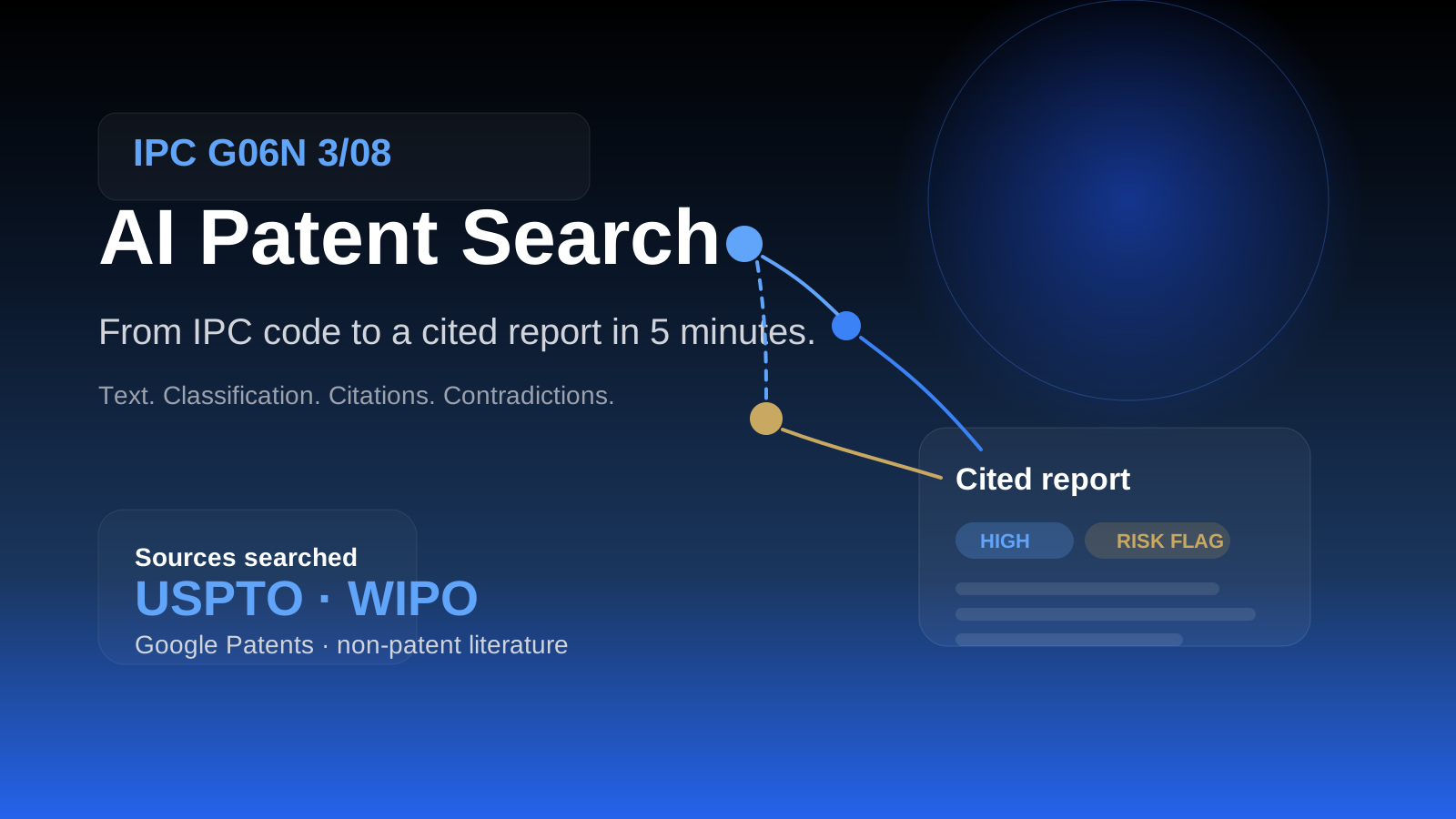
AI Patent Search: From IPC Code to Cited Report in 5 Minutes
Patent search is not one query. It is text, classification, citations, and non-patent literature across multiple databases. Here is the workflow that gets you from an IPC code to a cited report faster without pretending verification is optional.
Ready to try honest research?
Rabbit Hole shows you different perspectives, not false synthesis. See confidence ratings for every finding.
 Try free