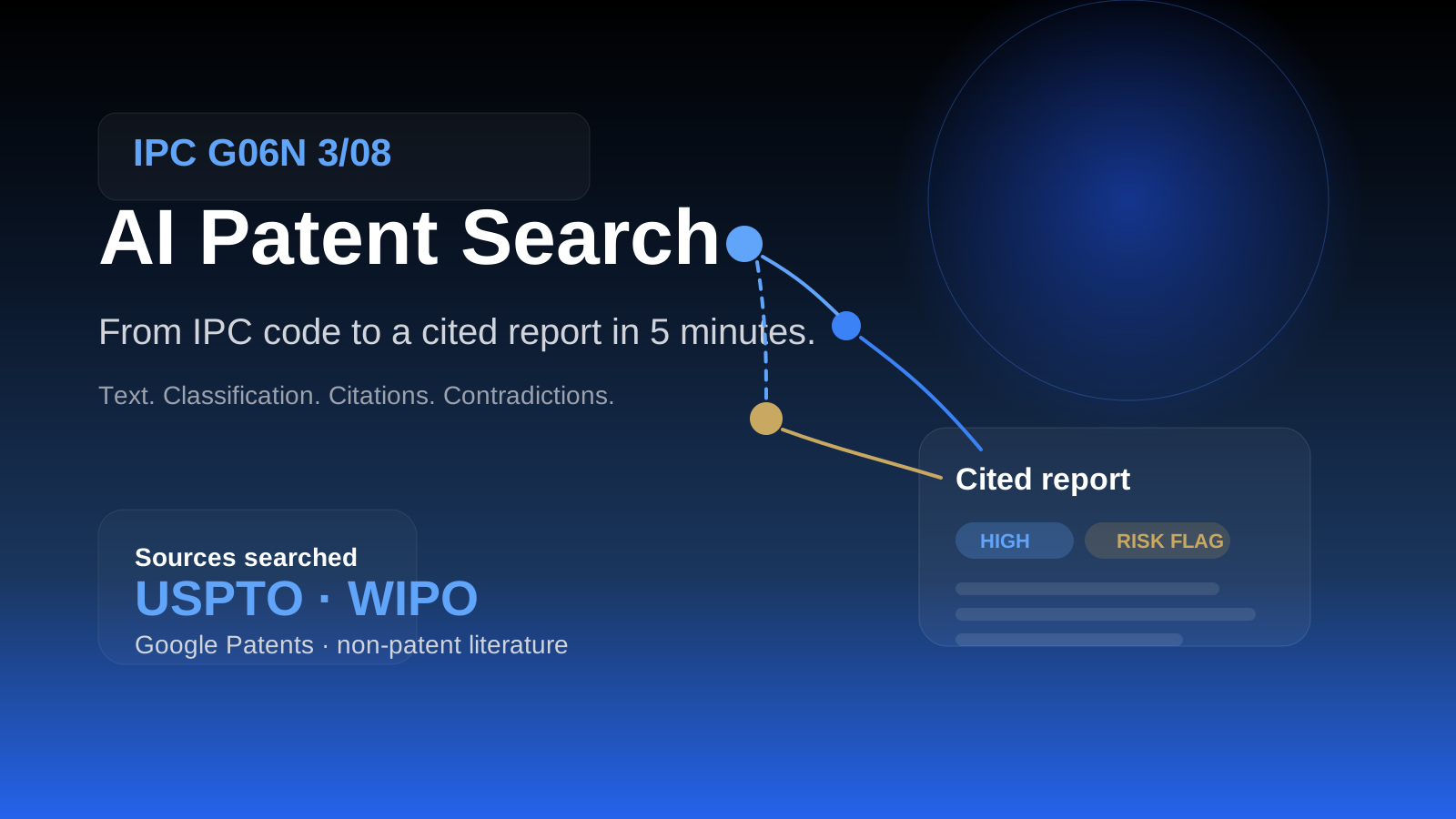
AI Patent Search: From IPC Code to Cited Report in 5 Minutes
Patent search is not one query. It is text, classification, citations, and non-patent literature across multiple databases. Here is the workflow that gets you from an IPC code to a cited report faster without pretending verification is optional.
Patent search is still usually treated like a better keyword box. That is the wrong mental model.
The USPTO's own prior-art-search training says a complete search uses three methods: text searching, patent classification searching, and patent citation searching. Google Patents adds another quiet requirement: if you want a complete view of the state of the art, you also need to search non-patent literature, not just patents. That is why patent search work still turns into hours of query rewrites, class-code hopping, citation chasing, and manual memo-writing. USPTO Basics of Prior Art Searching (PDF) Google Patents coverage help
Quick verdict: AI patent search is useful when it compresses the messy middle — IPC lookup, multilingual search, citation clustering, and memo assembly. It is not useful when it pretends one keyword query equals a defensible prior-art review.
Sources: Google Patents coverage, USPTO prior-art-search basics, PatSnap pricing, Rabbit Hole pricing.
What an AI patent search should do in the first 5 minutes
| If your real job is... | The workflow you need | What still needs a human | Why this split matters |
|---|---|---|---|
| Checking whether an invention idea is obviously crowded | IPC + keyword search across Google Patents, PATENTSCOPE, and USPTO Patent Public Search | Claim interpretation | The fast question is not "is it patentable?" but "is this already a busy class?" |
| Preparing a prior-art memo for counsel or an R&D lead | Cross-database search, citation clustering, assignee grouping, cited report draft | Final legal judgment and claim scope | You want a starting memo, not a false sense of novelty |
| Running freedom-to-operate screening | Similar-claim detection, assignee monitoring, family lookups | Jurisdiction-specific infringement analysis | FTO risk turns on live claims, not abstract similarity |
| Tracking a technology area over time | Saved class-code searches, new-filing alerts, assignee trend summaries | Strategic interpretation | The real value is pattern detection, not one-off retrieval |
If your work sits closer to diligence than prosecution, the adjacent workflow is AI Due Diligence, where contradiction checks matter more than eloquent summaries. If you are mapping competitor direction rather than novelty, the practical sibling is Competitive Intelligence Without the Spyware Budget, because patent filings are often the cleanest public signal of technical intent. If you need the broader workflow discipline behind this post, start with How to Research Any Topic, which treats patents as one evidence layer rather than the whole answer.
Why patent search is slower than it looks
A complete patent search is not one database and not one search style.
The USPTO's training materials break prior-art searching into three parts:
- Text searching for the language an inventor or examiner might use
- Patent classification searching to find documents that describe the same technical idea differently
- Patent citation searching to follow the references that patents and examiners already considered relevant
That structure matters because language drifts. A neural-network filing might say learning methods, training routines, parameter updates, or model optimization without using the exact phrase you started with. Classification codes are what keep the search from collapsing into synonym roulette. USPTO Basics of Prior Art Searching (PDF)
WIPO's International Patent Classification exists for exactly this reason: a hierarchical, language-independent system of symbols for classifying patents by technology area. If you start with the wrong class, you can miss the neighborhood entirely. WIPO IPC overview
Start with an IPC code, not just a prompt
A concrete example helps. Suppose you are exploring novelty around machine-learning training methods. WIPO's IPC scheme maps G06N 3/08 to learning methods within neural-network systems. That code is not the whole search. It is the anchor that keeps the search from drifting into generic AI chatter. WIPO IPC G06N 3/08
Here is the practical pattern:
- Start with the technology question in plain English. Example: "What prior art already covers adaptive training methods for neural networks used in edge devices?"
- Map it to an IPC or CPC neighborhood. Here, that may start with
G06N 3/08and then expand into adjacent subclasses if the first pass is too narrow. - Run the class code across multiple databases. USPTO Patent Public Search, Google Patents, and PATENTSCOPE are complementary, not interchangeable.
- Pull citation neighborhoods. The closest filing is usually a better query than your original query.
- Draft the memo from the evidence, not from the first answer. The point is a cited report you can hand to counsel or an R&D lead, not a chat transcript.
The free-stack workflow: USPTO + Google Patents + PATENTSCOPE
You do not need an enterprise platform to start cleanly. You do need to understand what each public tool is good at.
| Tool | Best for | What it adds | Where it stops |
|---|---|---|---|
| USPTO Patent Public Search | U.S. patents and published applications | Web-based basic and advanced search with full query options | U.S.-centric; still expects you to know what to ask |
| Google Patents | Breadth and speed | 120M+ publications from 100+ offices plus non-patent literature, machine translation, CPC-aware search | Coverage is broad, but Google itself says it cannot guarantee complete coverage |
| WIPO PATENTSCOPE | International filing coverage | PCT applications plus national and regional collections, multilingual search, IPC-first workflow | National collection depth varies by office |
Google Patents is the quiet workhorse here because it combines patents with technical documents and books from Google Scholar and Google Books, then machine-classifies those materials to make prior-art discovery easier. That matters because non-patent literature is often where a novelty argument starts to weaken. Google Patents coverage help
The USPTO's Patent Public Search tool matters for a different reason: it is the official U.S. search surface, with basic and advanced modes and support for structured searching across patents and published applications. USPTO Patent Public Search
PATENTSCOPE matters when the risk is international blind spots. WIPO describes it as access to published PCT applications, national and regional collections, and non-patent literature, with search by keywords, IPC, chemical compounds, numbers, and more. WIPO PATENTSCOPE
What AI changes — and what it does not
The useful version of AI patent search does four things well:
1. It expands the query without losing the class code
Keyword search alone misses too much. AI is good at generating alternative terminology, related technical phrases, and likely adjacent subclasses. The mistake is letting the model free-associate without class constraints. The class code is the guardrail.
2. It clusters citations into themes instead of one long list
The useful output is not fifty patents ranked by vague relevance. It is groups like:
- training-method patents
- hardware-implementation patents
- edge-deployment patents
- contradictory prior art that weakens the novelty thesis
That is where a report becomes more useful than a search-results page.
3. It makes contradiction visible
This is the part most tools still skip. A real prior-art review should surface the filings that hurt your thesis fastest, not bury them. If one reference is a near-match on the core claim, that needs to be the headline.
4. It produces a memo, not just retrieval
A good output looks like this:
- Query: what technical question was searched
- Class codes used: IPC/CPC starting points
- Databases covered: USPTO, Google Patents, PATENTSCOPE, plus non-patent literature where relevant
- Closest references: with publication numbers, assignees, dates, and why they matter
- Contradictions / risk points: what most weakens novelty
- Open gaps: what still requires counsel or deeper claim review
That last section matters as much as the citations. A report that looks definitive too early is the dangerous one.
Enterprise patent tools are selling workflow, not just search
PatSnap's current pricing makes the market split visible. Its patent-searching Pro plan starts at $400/month; enterprise pricing is quote-based. That tells you what these tools are really selling: team workflow, volume, and process packaging, not just database access. PatSnap pricing
Rabbit Hole sits on the opposite end of that curve: 3 free reports, then Basic at $29/month and Plus at $79/month. The positioning is different. It is not trying to replace a mature patent-ops system. It is trying to give an individual researcher, founder, analyst, or small legal team a faster path from a technical question to a cited first-pass report. Rabbit Hole pricing
The real comparison is not free versus paid. It is search surface versus workflow system versus cited deliverable.
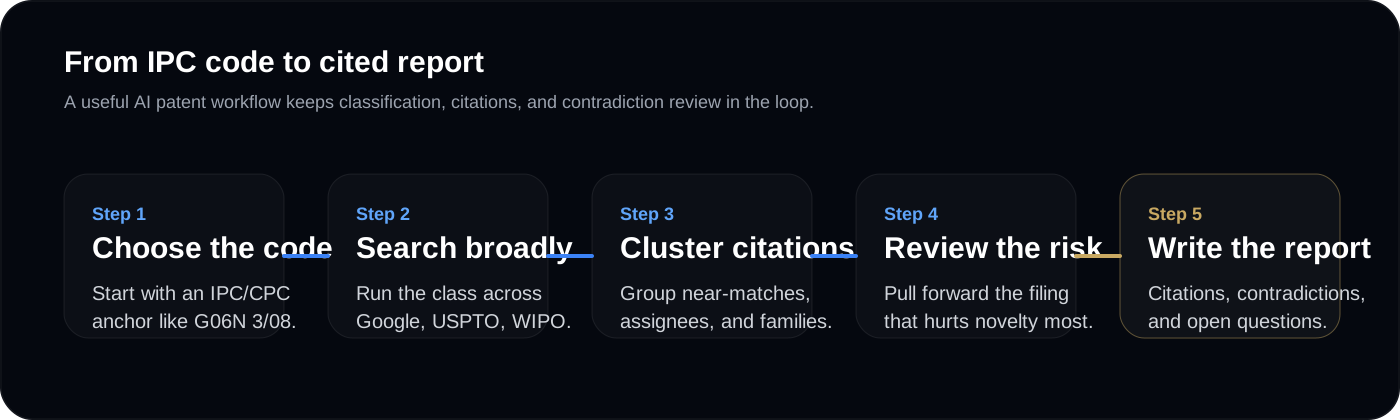
A concrete 5-minute workflow from IPC to cited report
Here is the workflow that actually earns the headline.
Minute 1: anchor the class
Find the IPC/CPC neighborhood first. For our example, G06N 3/08 gives you a concrete anchor for learning methods in neural-network systems. Expand only after you have one stable home class.
Minute 2: run the class in Google Patents
Use the class with a plain-English phrase and include non-patent literature. Google Patents explicitly supports keyword-plus-class searching and can pull in Scholar-indexed technical documents alongside patents. Google Patents searching help
Minute 3: validate the U.S. set in USPTO Patent Public Search
Move the strongest-looking references into USPTO Patent Public Search to check how the U.S. filings line up, tighten the query, and catch publication/application variants. USPTO Patent Public Search
Minute 4: widen internationally in PATENTSCOPE
Run the same class and core phrases in PATENTSCOPE to see whether the U.S.-centric set missed international filings or PCT applications. WIPO PATENTSCOPE
Minute 5: write the first-pass memo
Summarize the closest references, the most important contradiction, the assignees involved, and what still needs counsel. That is the deliverable.
What AI patent search still cannot do for you
There are three places where you still need a human:
- Claim interpretation. Similar language does not automatically equal invalidating prior art.
- Jurisdiction and legal status. A search result is not an enforceability conclusion.
- Freedom-to-operate judgment. FTO is not the same as novelty, and a model that blends them is not helping.
The safest mental model is this: AI patent search is your first disciplined analyst, not your final patent opinion.
If your workflow is broader than patents and you are pressure-testing whole markets, pair this with Best AI Research Assistants for 2026. If your question is whether the research process itself is trustworthy, the sharper adjacent read is How to Verify AI Research. And if the work is legal enough that the citation chain itself is the risk, go straight to AI Legal Research: What Westlaw and LexisNexis Won't Tell You.
FAQ
What is the best AI patent search workflow in 2026?
The best AI patent search workflow starts with a class code, runs across at least one official database and one broad global database, then ends in a cited memo that names contradictions instead of hiding them.
Is Google Patents enough for prior-art searching?
No. Google Patents is excellent for breadth and speed, especially because it includes non-patent literature, but even Google says complete coverage is not guaranteed. It is a strong layer, not the whole search.
Why start with IPC or CPC codes instead of keywords?
Because patents often describe the same technical idea with different vocabulary. Class codes are the language-independent anchor that stops the search from drifting.
Can AI patent search replace a patent attorney?
No. It can reduce the time spent getting to the relevant documents and writing the first-pass report. It cannot replace claim interpretation, legal strategy, or final patentability and FTO judgment.
Rabbit Hole helps you move from a technical question to a cited report with class-code-aware search, contradiction review, and reusable research artifacts. Try Rabbit Hole free.
Related Articles
The 2026 Buyer's Guide to AI-Powered Research Assistants
The best ai-powered research assistant in 2026 depends on whether you need a fast answer, a literature workflow, or a report you can actually defend after the meeting.

ChatGPT Deep Research vs Perplexity vs Rabbit Hole: Which One Cites Sources That Actually Exist?
If a deep research tool gives you a polished paragraph with one dead link or one unsupported claim, the report is already compromised. Here is the citation test that matters.
Zotero + AI: Building a Research Workflow That Actually Cites
Zotero already solves storage and citations. The missing layer is faster discovery with verification before weak sources make it into your library.
Ready to try honest research?
Rabbit Hole shows you different perspectives, not false synthesis. See confidence ratings for every finding.
 Try free