
How to Verify AI Research Output
A systematic workflow to fact-check AI-generated research, catch hallucinated citations, and verify sources before trusting the output.

Last November, a peer-reviewed paper in China Population and Development Studies was found to contain at least 20 non-existent references out of 61. Professional reviewers missed it. A social media user caught it.
The problem wasn't sloppy formatting. It was AI-shaped citation failure slipping past normal review. And it wasn't isolated. The Tow Center for Digital Journalism found that AI search tools returned incorrect answers to more than 60% of citation-style news queries. A May 2026 Lancet-linked audit summarized by ThePrint found fabricated references in 1 out of every 277 biomedical papers published in early 2026.
If PhD advisors and peer reviewers can't spot fake citations, how are regular researchers supposed to? The answer is systematic verification. Not skimming, not trusting your gut—following a repeatable process that catches hallucinations before they make it into your work.
Fast path: Jump to the 5-step workflow · Jump to the 15-minute triage queue · Jump to tools that help
Why This Matters Now
This problem is not theoretical. We showed how polished deep research reports create false confidence in Deep Research Tools Look Credible. That's the Problem., we compared the major options in Best AI Research Assistants for 2026, we published a tool-specific breakdown in ChatGPT Deep Research Review (2026), and we broke down why prompt injection becomes operationally dangerous once an agent has tools, memory, and permissions in The OpenClaw Security Wake-Up Call.
AI research tools have improved dramatically. They can find relevant papers, synthesize arguments, and generate citations faster than any human. But the confidence layer still outruns the truth layer. Tow Center's March 2025 test showed that even premium AI search products were often confidently wrong, and the 2026 fabricated-reference audit suggests the contamination now reaches the formal literature, not just chat windows.
That means verification is now a two-front problem:
- Did the source exist when the model cited it?
- Does the source actually support the claim the model made?
Once verified research is ready to publish, the next problem is structural: pages still need to be formatted for AI search optimization and LLM citations so the evidence is extractable, not just accurate.
Here's the issue: hallucinated citations look exactly like real ones. They follow proper formatting. The titles sound academic. Author names are plausible. Journal names are correct. Everything appears legitimate because the AI learned what legitimate citations look like—not what they are.
The stakes matter too. A fake citation in a fertility trends paper is embarrassing. A fake citation in a medical study or engineering paper can cause real harm. Once a fake citation enters the literature, other researchers cite it, creating chains of scholarship built partially on fiction.
The 5-Step Verification Workflow
Don't treat AI research tools as authoritative sources. Treat them as research interns who work fast but need supervision. Here's the verification workflow that catches hallucinations before they propagate.
This is a triage sequence, not a percentage claim. When you're rushed, verify existence and claim support before anything else.
Step 1: Verify Citations Exist
Start with the simplest check: does this source actually exist?
For academic papers:
-
Search the exact title in Google Scholar (use quotation marks)
-
If that fails, search the author name + keywords from the title
-
Check if the journal actually published an article with that title in the cited year
-
Use the DOI if provided—real DOIs resolve to actual papers
For books:
-
Search Google Books using title and author
-
Check WorldCat for library holdings
-
Verify the ISBN if provided
For web sources:
-
Click the link (obvious but often skipped)
-
Use the Wayback Machine for older sources that may have moved
-
Check the domain—is this a credible source or content farm?
Red flags that indicate hallucination:
-
The source sounds perfect but you can't find it anywhere
-
Author names are generic ("John Smith," "Jane Doe")
-
URLs return 404 errors or redirect to unrelated pages
-
The journal name is slightly off (e.g., "Journal of Applied Psychology" vs. "Journal of Applied Psychological Science")
If a citation doesn't pass this check, flag it. Don't use it. Don't assume the AI made a small error—the entire citation may be fabricated.
Step 2: Check Quote Accuracy
Finding the source isn't enough. The AI might have found a real paper but attributed the wrong conclusion to it.
What to verify:
-
Does the cited paper actually say what the AI claims it says?
-
Is the quote in context, or cherry-picked to support a different argument?
-
Does the paper's conclusion match how the AI characterized it?
How to check:
-
Access the full text (not just the abstract)
-
Use Ctrl+F to search for keywords from the quote
-
Read the surrounding paragraphs for context
-
Check if the paper's stated conclusion aligns with the AI's summary
A common pattern: the AI finds a paper that mentions a keyword, then claims the paper supports a broader conclusion than it actually does. This is harder to catch than fake citations because the source exists—but the characterization is wrong.
Step 3: Cross-Reference Claims
One source agreeing with the AI isn't enough. Strong claims need multiple independent sources.
Cross-checking process:
-
Take a key statistic or claim from the AI output
-
Search for it independently (don't rely on the AI's sources)
-
Find at least two independent sources that confirm the same fact
-
Check if the sources have different methodologies that converge on the same conclusion
Example: If the AI claims "90% of researchers use open-access platforms," don't trust it until you find the original survey or study that produced this number. Then verify that the survey methodology was sound and the sample size was adequate.
Multiple sources saying the same thing doesn't guarantee truth, but it dramatically reduces the chance of hallucination or bias in a single source.
Step 4: Verify Timeliness
AI training data has cutoff dates. Web search helps, but not always. Outdated information is particularly dangerous for fast-moving topics like technology, medicine, or current events.
What to check:
-
When was the cited paper published?
-
Has newer research superseded these findings?
-
Are you citing a 2023 study about AI capabilities when 2025 benchmarks exist?
How to stay current:
-
Sort Google Scholar results by date
-
Check if the journal has published corrections or retractions
-
Look for review papers that synthesize recent findings
-
Set up Google Scholar alerts for your key topics
A 2024 paper citing 2021 data about AI capabilities is already outdated. In fast-moving fields, prioritize sources from the last 12-18 months unless you're specifically discussing historical developments.
Step 5: Evaluate Source Quality
Not all real sources are good sources. Predatory journals, content farms, and low-quality outlets publish real papers that shouldn't be cited.
Use the CRAAP test:
-
Currency: When was it published? Is it still relevant?
-
Relevance: Does it directly address your topic or just mention keywords?
-
Authority: Is the author qualified? Is the journal peer-reviewed?
-
Accuracy: Is the methodology sound? Are conclusions supported by data?
-
Purpose: Is this trying to inform, sell, persuade, or entertain?
Red flags for low-quality sources:
-
Journals that charge authors high fees with minimal peer review (predatory journals)
-
Sources with no author attribution
-
Blogs or opinion pieces presented as research
-
Papers with conflicts of interest not disclosed
Real citations to bad sources are almost as problematic as fake citations. The CRAAP test catches both.
The 15-Minute Triage Queue When You Can't Verify Everything
If someone drops a 20-source AI-generated memo on your desk and you only have 15 minutes, verify in this order:
| Minutes | Check | What you are trying to catch | Keep going if... | Stop and investigate if... |
|---|---|---|---|---|
| 0-5 | Existence check | Fully fabricated papers, dead URLs, fake journal issues | The source resolves cleanly to a paper, book, or page that exists | The DOI is dead, the title doesn't exist, or the URL redirects somewhere unrelated |
| 5-9 | Claim support check | Real source, wrong conclusion | The abstract or relevant section clearly supports the sentence you're relying on | The paper mentions the topic but doesn't support the claim being made |
| 9-12 | Corroboration check | Single-source overreach | A second independent source lands in roughly the same place | The number or conclusion only appears in one place |
| 12-14 | Freshness check | Outdated evidence presented as current | The source is recent enough for the field or still foundational | The report leans on pre-boom benchmarks in a fast-moving area |
| 14-15 | Venue quality check | Predatory journals and weak evidence | The venue and author credentials hold up | The citation is technically real but comes from a low-trust source |
The point of this queue is not perfection. It is damage control. Most bad AI research breaks at the existence layer or the claim-support layer. Catch those first.
Tools That Help (And Their Limits)
Several tools can speed up verification, but none replace human judgment:
Google Scholar — Essential for finding papers and checking citations. Use the "cited by" feature to see if other researchers have validated (or refuted) the findings.
Research Rabbit — Visualizes citation networks. Helps you trace how ideas evolved and find related work the AI might have missed.
SciWeave / Consensus — These tools search academic databases and summarize findings with actual citations. They're better than general-purpose AI for academic queries because they're grounded in real papers.
Zotero / Mendeley — Citation managers that can check DOIs and metadata. Useful for organizing sources and catching formatting errors that might indicate deeper problems.
Limitations to remember:
-
AI detectors (GPTZero, etc.) can't reliably detect hallucinated citations
-
Automated citation generators sometimes produce plausible-looking fake citations
-
No tool catches contextual misrepresentation—only human review does that
When to Trust, When to Verify
Not every claim needs full verification. Prioritize based on risk:
Full verification required:
-
Statistics or specific numbers
-
Quotes from named individuals
-
Claims that form the foundation of your argument
-
Medical, legal, or safety-critical information
Light verification sufficient:
-
General background that doesn't affect your core argument
-
Claims you already know to be true from your own expertise
-
Common knowledge in your field
Red line—never trust AI for:
-
Citations in your final bibliography without checking each one
-
Medical advice or treatment recommendations
-
Legal interpretations or compliance guidance
-
Financial or investment analysis
Building the Habit
The researchers who get caught by hallucinations aren't careless—they're rushed. Verification feels like it slows you down, but one fake citation can cost hours of cleanup, damage your credibility, or get your paper retracted.
Make verification automatic:
-
Keep this workflow visible while researching
-
Batch verification—don't check citations as you find them, collect them and verify in batches
-
Build a personal database of verified, high-quality sources you can reuse
-
When in doubt, leave it out—better to have fewer citations than fake ones
The goal isn't to eliminate AI from your research workflow. AI tools are too useful for that. The goal is to add a verification layer that catches errors before they propagate. If the research is feeding an investment, vendor, or partnership decision, use that same verification discipline inside an AI due diligence workflow so the meeting memo preserves contradictions instead of smoothing them away. If your workflow is academic rather than commercial, apply the same discipline to an AI literature review tool so the speed gain does not quietly turn into a citation-quality problem.
Summary
AI hallucinations aren't bugs—they're inherent to how language models work. They predict plausible-sounding text, not truth. That means verification isn't optional; it's part of the research process.
Follow the five steps: verify citations exist, check quote accuracy, cross-reference claims, verify timeliness, and evaluate source quality. Use tools to speed up the process, but don't delegate judgment.
The Hong Kong paper with 20 fake citations made it through peer review. It was only caught because someone took the time to check. Be that person. Your credibility depends on it.
Related Articles
The 2026 Buyer's Guide to AI-Powered Research Assistants
The best ai-powered research assistant in 2026 depends on whether you need a fast answer, a literature workflow, or a report you can actually defend after the meeting.
ChatGPT Deep Research vs Perplexity vs Rabbit Hole: Which One Cites Sources That Actually Exist?
If a deep research tool gives you a polished paragraph with one dead link or one unsupported claim, the report is already compromised. Here is the citation test that matters.
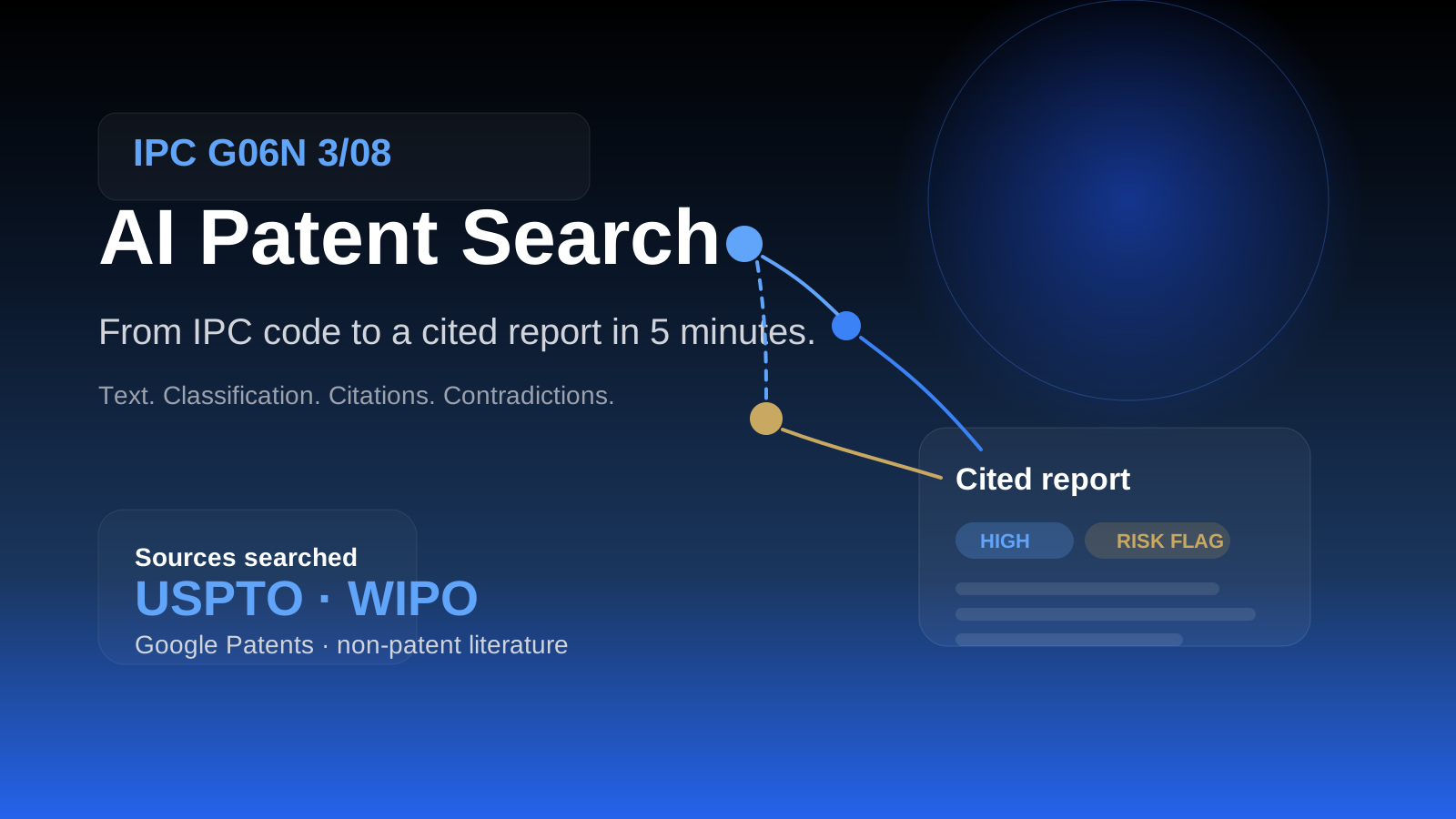
AI Patent Search: From IPC Code to Cited Report in 5 Minutes
Patent search is not one query. It is text, classification, citations, and non-patent literature across multiple databases. Here is the workflow that gets you from an IPC code to a cited report faster without pretending verification is optional.
Ready to try honest research?
Rabbit Hole shows you different perspectives, not false synthesis. See confidence ratings for every finding.
 Try free