

AI Search Optimization: How to Structure Research for LLM Citations
AI search optimization now determines who gets cited by ChatGPT, Perplexity, and AI Overviews. Here's how to structure research for LLM citations.
The rules of discoverability just changed.
In March 2026, Google confirmed what many suspected: AI Overviews now appear on 30-48% of all searches, up from single digits just 18 months ago. ChatGPT processes 2.5 billion prompts daily. Perplexity, Claude, and Gemini have become the starting point for research across every industry.
Here's what most businesses haven't internalized yet: Traditional SEO rank no longer guarantees visibility.
Semrush's analysis of 20,000 URLs found that only 12% of ChatGPT citations match URLs that also appear on Google's first page. The correlation between ranking #1 on Google and being cited by AI systems has weakened to the point of irrelevance for many queries.
The new game is Generative Engine Optimization (GEO) — structuring your content and research so AI agents can find it, trust it, and cite it when answering user questions.
This matters for anyone publishing research, data, or expertise online. AI search optimization now matters as much as classic ranking signals, because the pages AI systems cite shape what customers see before they ever click.
Quick Answer: What Is AI Search Optimization?
AI search optimization means structuring research so LLMs can extract, verify, and cite it — not just rank it. In practice, that means leading with findings, using question-based headings, adding 40-60 word answer blocks, and backing claims with linked statistics that an AI system can defend.
This matters for anyone publishing research, data, or expertise online. The way you've optimized content for the past decade won't work for the next one.
Use this page fast: Start with the five-point readiness checklist below, then use the new publish-order table to fix the highest-leverage structural gaps first. If you only change one thing this week, add a direct answer block to the first screen of your highest-intent page.
Start Here: The AI Citation Readiness Checklist
If you want a page to earn LLM citations, check these five things before you publish:
| Check | What good looks like | Why it matters for AI search optimization |
|---|---|---|
| Direct answer near the top | First screen answers the query in 40-60 words | AI systems overweight early extractable content |
| Question-led headings | Headings mirror the exact question a user would ask | Improves query-to-passage matching for LLM citations |
| Linked statistics | Claims include source links, dates, and concrete numbers | Makes the answer easier for models to defend |
| Modular formatting | Tables, bullets, FAQs, and summary blocks break up dense prose | Gives answer engines clean chunks to retrieve |
| Freshness signal | Updated dates and recent stats are visible in the copy | Recency often functions as a trust filter |
If your page fails three or more of those checks, it is probably still written for blue-link SEO instead of AI search. If your team is still solving the earlier trust problem first, start with our breakdown of why AI search can be confidently wrong and the broader deep research credibility problem.
What to Fix First on a Page You Want LLMs to Cite
| If this is missing | Add this first | Why it matters for LLM citations |
|---|---|---|
| No direct answer above the fold | A 40-60 word answer block immediately under the intro | It gives ChatGPT, Perplexity, and AI Overviews a clean passage to extract without guessing |
| Dense narrative with few scan points | A checklist, comparison table, or FAQ block every 2-3 scrolls | Modular structures are easier for answer engines to retrieve than essay-only prose |
| Claims without visible evidence | Linked stats with source name and year in the same paragraph | It makes the page more defensible for both readers and AI systems |
| Strong research buried late | A key-findings summary near the top | 44.2% of citations come from the first 30% of the page |
| Old but otherwise useful page | Refresh date plus one or two recent statistics | Freshness often acts as a trust filter in AI search surfaces |
This is the shift many teams miss: AI search optimization is not mostly about writing more. It is about moving proof, answers, and structure earlier so the page becomes easier to extract, trust, and cite.
The Data: What Actually Drives AI Citations
A 2026 benchmark study analyzing 4 million AI citations revealed patterns that contradict traditional SEO wisdom:
Citation Location Patterns
44.2% of LLM citations come from the first 30% of your content.
AI systems weight early content heavily. The executive summary, introduction, and first few sections of your research report carry disproportionate influence over whether you get cited at all.
Traditional long-form content buries key insights deep in the body. That's now a structural disadvantage.
Content Type Preferences
Content with statistics sees 28-40% higher visibility in AI search.
AI systems prioritize content they can verify and defend. Hard numbers, cited research, and data-backed claims are disproportionately rewarded compared to opinion or narrative content.
This creates a paradox: the content that ranks well for human readers (story-driven, engaging narrative) differs from what AI systems prioritize for citations (structured, fact-dense, modular).
The Domain Authority Cliff
Sites with 32,000+ referring domains are 3.5x more likely to be cited by ChatGPT.
The rich get richer. AI systems appear to use domain-level trust signals as a filter before evaluating individual pages. Small sites with excellent content face a discoverability problem that didn't exist in traditional SEO.
However, there's an exception: content that answers specific technical questions with precision can overcome domain authority deficits. The path for smaller players is narrow but viable — extreme specificity and depth on narrow topics.
How AI Search Differs from Traditional Search
Understanding the technical differences explains why your current optimization strategy isn't working.
AI systems still inherit some classic SEO signals, but they increasingly reward citation-ready structure over raw page rank.
| Dimension | Traditional SEO | AI search optimization |
|---|---|---|
| Unit of retrieval | Whole page | 40-60 word answer block |
| Winning structure | Keyword-targeted page | Question-led, modular page |
| Trust signal | Backlinks + rank | Defensible claims + linked evidence |
| Freshness effect | Helpful | Often critical |
| Writer goal | Rank high | Become extractable and citable |
Answer Blocks vs. Pages
Traditional SEO optimizes entire pages for keyword relevance. AI search extracts answer blocks — 40-60 word passages that directly address specific questions.
The benchmark data is clear: 83% of top-ranking AI-cited content includes 40-60 word direct answer blocks after each heading.
Your page might rank #1 for "best CRM software" but never get cited by AI systems if it doesn't contain modular, self-contained answer blocks like:
"Salesforce leads the enterprise CRM market with 23.8% market share as of 2026, according to Gartner. Its primary advantages include extensive customization, AI-powered forecasting, and the largest third-party app ecosystem. Pricing starts at $165/user/month for enterprise features."
That's 43 words. It contains a statistic, source, context, and concrete detail. AI systems can confidently extract and cite it.
Question-Based Structure
78% of top-ranking AI-cited content uses question-based H2 headings.
AI systems map queries to questions. When a user asks "What CRM should I use for a 50-person sales team?" the AI looks for content that explicitly answers that question — not content that happens to mention CRM software and team size somewhere in the text.
Headings like "Salesforce for Mid-Market Teams" require inference. Headings like "What's the best CRM for a 50-person sales team?" match the AI's query structure directly.
Multiple AI Surfaces, Different Rules
Only 13.7% of citations overlap between AI Overviews and AI Mode.
Google's different AI features cite different sources. Content optimized for AI Overviews may not appear in AI Mode, and vice versa. This fragmentation means "AI optimization" isn't a single target — it's multiple optimization targets with overlapping but distinct requirements.
The practical implication: diversify your content structure. Don't optimize for a single AI citation pattern. Include multiple answer formats, question variations, and statistical depths to maximize cross-platform visibility.
The Research Implications
For research-driven businesses — consultancies, SaaS companies, industry analysts — the shift to AI search changes how research should be produced and published.
1. Lead With Findings
The traditional research report structure (introduction → methodology → findings → conclusion) buries your most citable content.
Instead, use an inverted pyramid: lead with key findings in a scannable format, then provide methodology and deep analysis for readers who want it. This serves both AI systems (which extract early) and human readers (who can dive deeper if interested).
2. Modularize Everything
Break research into discrete, self-contained units. Each statistic should include context and source. Each finding should stand alone. Think encyclopedia entries, not essays.
The goal: any paragraph in your research should be extractable and still make sense with full context.
3. Cite Aggressively
AI systems appear to use citation density as a quality signal. Content that cites external sources is trusted more than content that doesn't. This creates a virtuous cycle: citing reputable sources increases your likelihood of being cited yourself.
91% of top-ranking AI-cited content contains 5+ hyperlinked statistics from external sources.
Don't just say "studies show." Link to the specific study. Name the researcher. Provide the publication date. This specificity builds machine-readable trust signals.
4. Optimize for AI Personas
Different AI systems have different citation patterns:
ChatGPT/Claude: Prioritize comprehensive, nuanced answers with multiple perspectives. Cite sources that acknowledge complexity and trade-offs.
Perplexity: Heavily weight real-time information and recent sources. Update content frequently to maintain visibility.
Google AI Overviews: Favor content from established medical, financial, and technical authorities. Domain authority matters more here than in other systems.
Gemini: Strong preference for Google's own ecosystem (YouTube transcripts, Google Scholar, Google Books). Include YouTube summaries and academic citations where relevant.
The Trust Factor: How AI Agents Choose What to Recommend
Wharton research published in March 2026 revealed how AI agents evaluate brands for recommendations — and it's not about traditional marketing metrics.
AI agents prioritize defensibility. They recommend brands for which they can construct clear, fact-based rationale. This means:
- Machine-readable product data (structured specifications, pricing tables)
- Transparent, verifiable claims (not superlatives, but specifics)
- Third-party validation (reviews, certifications, analyst reports)
- Open documentation (API docs, help centers, technical specifications)
The brands winning AI citations aren't necessarily the biggest or best-marketed. They're the most legible to AI systems.
A startup with comprehensive, structured product documentation may be cited more frequently than an established competitor with better brand awareness but opaque information architecture.
How Research Teams Should Adapt Their Workflow
Research teams that want AI citations should stop treating publication as a formatting step and start treating it as an extraction problem.
- Start every research page with a direct answer block. If the first screen does not answer the question, AI systems may never reach the strongest material later in the page.
- Pair every important claim with a linked source. That same discipline is what makes AI-generated research easier to verify and reuse. Rabbit Hole's source-backed workflow matters here because it keeps the citation attached to the claim instead of forcing teams to reconstruct evidence later.
- Publish comparison tables, checklists, and summary blocks — not just narrative paragraphs. AI systems extract modular structures more reliably than essay-style prose.
- Refresh fact-heavy pages on a fixed cadence. Recency is often part of the trust signal, especially for fast-moving tool categories.
- Use research tools that preserve source context all the way to publish. If your workflow breaks the link between a claim and its evidence, your page becomes harder for both humans and LLMs to trust.
If your team is still publishing long narrative reports with buried findings, review how to verify AI research before you publish it, why AI search can sound confident while being wrong, and how the broader deep research credibility problem shows up in real workflows.
Action Steps: Optimize Your Research for AI Search
Immediate (This Week)
-
Audit your top 10 pages. Do they contain 40-60 word answer blocks for key questions? Add them if not.
-
Rewrite your headings. Convert noun phrases to questions. "Customer Acquisition Cost" becomes "What is a good customer acquisition cost for SaaS?"
-
Add FAQ sections. 67% of top-ranking AI-cited content includes dedicated FAQ sections, up from 31% in 2024.
Short-Term (This Month)
-
Implement structured data. Use Schema.org markup for datasets, research articles, and factual claims.
-
Create citation-ready assets. Build standalone statistic pages, glossary entries, and comparison tables that AI systems can extract cleanly.
-
Update content freshness. Add "last updated" dates. Refresh statistics quarterly. AI systems weight recency heavily for rapidly evolving topics.
Strategic (This Quarter)
-
Build topic authority clusters. Create interconnected content that covers a topic comprehensively. Use 15+ internal links per post (median for #1 positions).
-
Monitor AI citations. Track when and where your brand appears in AI responses. Tools like Perplexity and ChatGPT's browsing mode make this audit-able.
-
Create llms.txt files. The emerging standard for making content legible to AI crawlers. Similar to robots.txt but optimized for LLM understanding.
FAQ: LLM Citations and AI Search Optimization
What is AI search optimization?
AI search optimization is the practice of structuring content so ChatGPT, Perplexity, Gemini, Claude, and Google AI Overviews can extract, verify, and cite it. The goal is not just ranking in search results, but becoming the source an answer engine pulls into its response.
Do LLM citations follow Google rankings?
Not reliably. Semrush found that only 12% of ChatGPT citations overlap with Google's first-page URLs, which means strong traditional rankings do not guarantee visibility inside AI answers.
What content structure improves LLM citations?
The strongest pattern is modular, source-backed structure: question-led headings, 40-60 word answer blocks, linked statistics, and comparison tables that make claims legible without requiring the model to infer missing context.
The Bigger Picture
AI search isn't a feature. It's a platform shift.
The transition from blue-link SEO to AI citation optimization mirrors earlier transitions: from Yahoo directories to Google search, from desktop to mobile, from keywords to intent. Each shift rewarded early adopters and penalized laggards.
The data suggests this transition will accelerate. AI Overviews grew from 6.49% of searches in January 2025 to 13.1% by March 2025 to 30-48% today. The trajectory is clear.
Businesses that optimize for AI search today are building competitive moats that will widen over the next 18 months. Those that wait for the dust to settle will find themselves playing catch-up against opponents with 12-24 month head starts.
The research process itself needs to change. The goal isn't just to produce good research — it's to produce research that AI systems can discover, verify, and cite when your potential customers are asking questions.
That requires structural changes to how research is written, formatted, and published. The organizations that make those changes now will define the information landscape of the next decade.
Research Faster with AI That Preserves Source Context
Rabbit Hole is a research agent that finds, verifies, and synthesizes information from across the web — with full source citations you can verify yourself.
Unlike general AI tools that may hallucinate or rely on training data, Rabbit Hole conducts live research using multiple search engines, extracts specific facts with context, and keeps the evidence attached to the output so your team can publish citation-ready research instead of reverse-engineering proof later.
Built for the AI search era: Rabbit Hole helps teams create research artifacts with direct answers, linked evidence, and export-ready findings — the same structure AI systems are increasingly able to extract and cite.
Start researching with Rabbit Hole →
Sources: Semrush AI Search Trends 2026, Averi AI Content Marketing Benchmarks Report, Wharton AI Agent Research Study, SparkToro AI Recommendation Analysis
Related Articles
The 2026 Buyer's Guide to AI-Powered Research Assistants
The best ai-powered research assistant in 2026 depends on whether you need a fast answer, a literature workflow, or a report you can actually defend after the meeting.

ChatGPT Deep Research vs Perplexity vs Rabbit Hole: Which One Cites Sources That Actually Exist?
If a deep research tool gives you a polished paragraph with one dead link or one unsupported claim, the report is already compromised. Here is the citation test that matters.
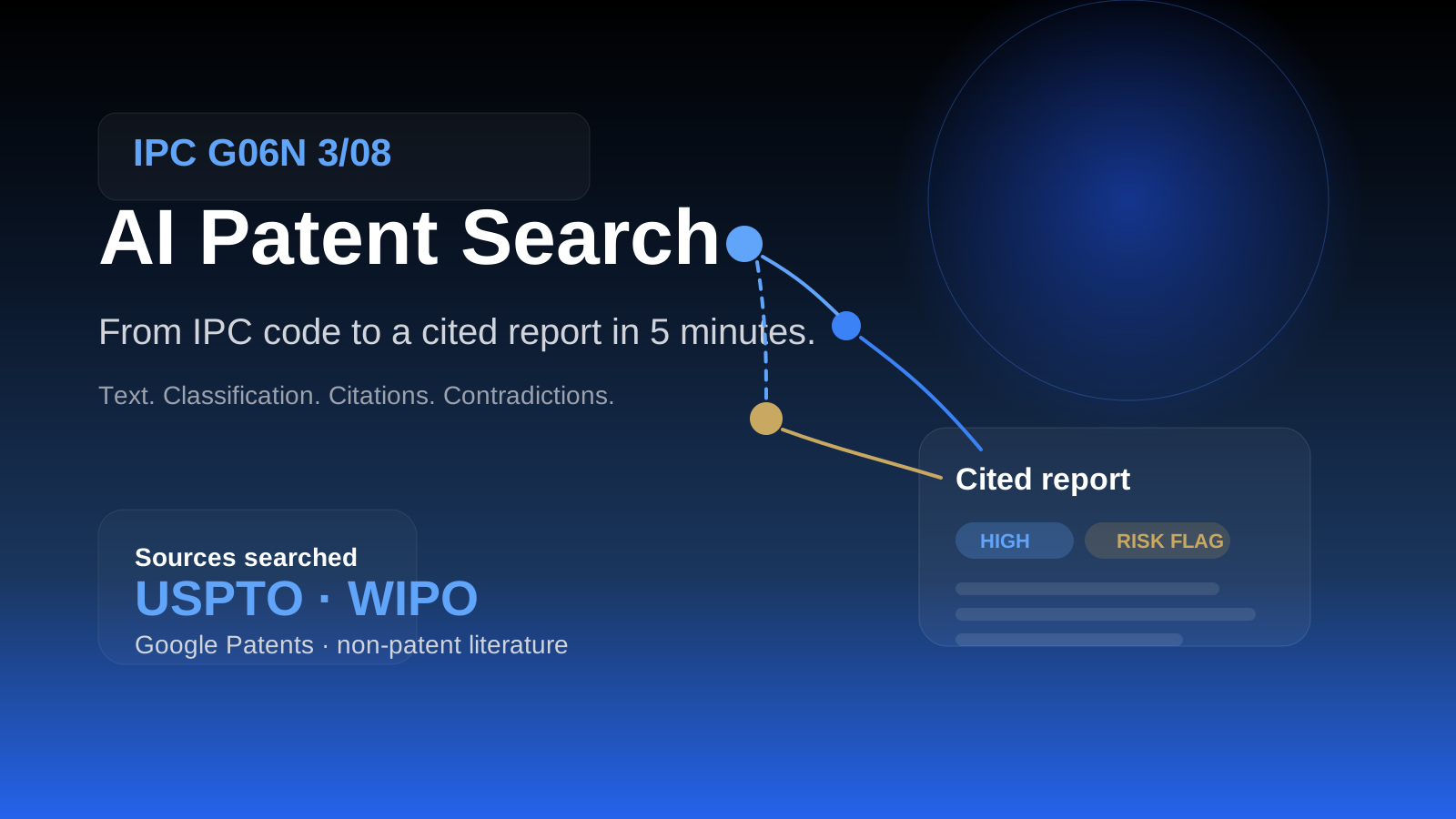
AI Patent Search: From IPC Code to Cited Report in 5 Minutes
Patent search is not one query. It is text, classification, citations, and non-patent literature across multiple databases. Here is the workflow that gets you from an IPC code to a cited report faster without pretending verification is optional.
Ready to try honest research?
Rabbit Hole shows you different perspectives, not false synthesis. See confidence ratings for every finding.
 Try free