

AI Literature Review: How to Review 100 Papers in Minutes, Not Months
Systematic literature reviews take 6-18 months. AI research tools compress the search and synthesis phases from weeks to minutes. Here's what actually works and what still needs a human.
If you want the short answer: an AI literature review tool is best for compressing discovery, screening, and first-pass synthesis -- not for replacing source verification or analytical judgment. The real win is that AI can turn the first month of a review into the first hour, as long as you still verify the backbone papers yourself.
Fast path: Jump to the 2-minute verdict · Jump to the 67-minute workflow · Jump to the verification framework · Jump to the FAQ
If you only have 2 minutes: when an AI literature review tool is worth using
| If your situation is... | Use an AI literature review tool? | Why |
|---|---|---|
| You need to map 100+ papers fast before a proposal, thesis, or evidence review | Yes | AI is strongest at discovery, clustering, and first-pass screening across multiple sources |
| You need exact citations for the 10 papers your argument depends on | Yes, with manual verification | The speed is real, but fabricated or misread citations can break the whole review |
| You are writing the final analytical argument or methodology section | Partly | AI can summarize patterns, but the interpretation still has to be yours |
| You need a publishable systematic review with PRISMA-grade rigor | No, not by itself | Database coverage, screening decisions, and reproducibility still need a human-led process |
Best use case: compress the messy discovery phase. Worst use case: blindly trusting the final references.
The speed gains are real, but citation accuracy remains the limiting constraint.
A systematic literature review in the social sciences takes an average of 67 weeks from registration to publication, and even published medical reviews can be months out of date by the time they appear in journals. By the time a review is published, dozens of new papers may already have landed in the same field.
Before you trust any AI literature review tool, run this five-point gate:
| 5-minute verification check | What you want to see | Red flag |
|---|---|---|
| Foundational papers | The obvious backbone studies appear early | The list is all recent summaries and no canonical work |
| Traceable citations | DOI, journal page, or database record is one click away | Citations are vague, incomplete, or citation-shaped filler |
| Method detail fidelity | Sample size, method, and limitation notes match the source PDF | The tool smooths methods into generic summaries |
| Contradictions preserved | Conflicting findings are surfaced clearly | The tool forces a clean consensus where none exists |
| Coverage gaps visible | It admits when non-English, paywalled, or older work may be missing | It acts comprehensive without naming blind spots |
If a tool fails 2 of these 5 checks, treat it like a search assistant, not a review assistant.
The process itself is brutally manual. A researcher defines search terms, runs them across multiple databases (PubMed, Scopus, Web of Science, Google Scholar), downloads hundreds of results, removes duplicates, screens abstracts, reads full texts, extracts data, synthesizes findings, and writes the review. Each stage is time-consuming, repetitive, and prone to human oversight -- especially the screening phase, where a single researcher might evaluate thousands of abstracts to find the few dozen that matter.
This is not just a workflow problem. It is a structural bottleneck in how knowledge accumulates. And AI is starting to crack it open.
How to choose an AI literature review tool in 2026
The easiest mistake is choosing an AI literature review tool the way you would choose a chatbot: by whichever demo sounds smartest. That is the wrong test. What matters is whether the tool helps you build a review you can defend when your advisor, reviewer, or coauthor asks, "where did that paper come from?"
Use this three-part filter before you trust any workflow:
| What to check in the first 10 minutes | Good sign | Bad sign |
|---|---|---|
| Database breadth | The tool can surface papers from multiple databases, preprints, and grey literature | It mostly paraphrases a narrow slice of open-web or recent papers |
| Citation traceability | You can click through to the original paper, DOI, or database record quickly | Citations are vague, incomplete, or hard to verify |
| Disagreement handling | The tool shows contradictory findings and missing evidence instead of smoothing everything into one answer | It produces a clean narrative that hides uncertainty |
The best AI literature review tool is not the one that feels most magical. It is the one that makes verification cheapest.
If you need a broader rubric for source-checking claims before they enter your draft, use our AI research verification workflow. If your work is closer to legal or compliance research, read the stricter standard in AI legal research, where a single bad citation can create actual sanction risk.
What an AI Literature Review Tool Actually Changes in the Review Process
A literature review has five phases: search, screening, extraction, synthesis, and writing. AI doesn't replace all of them equally.
Search: dramatically faster. Instead of manually constructing Boolean queries across six databases and hoping your keywords capture the relevant literature, AI tools can take a research question in natural language and retrieve papers across multiple sources simultaneously. A query like "what is the relationship between microplastic exposure and endocrine disruption in freshwater fish" returns relevant papers in seconds, not the hours of keyword iteration traditional database searching requires.
Screening: partially automated. This is where reviews lose months. Reading 3,000 abstracts to find the 50 that matter is exactly the kind of pattern-matching AI handles well. Tools can rank papers by relevance to your specific question, surface the most-cited work, and flag papers that cite each other -- revealing clusters of related research you might otherwise miss.
Extraction: emerging but imperfect. Pulling specific data points from papers -- sample sizes, effect sizes, methodologies, key findings -- is possible with AI but still requires human verification. A language model can read a methods section and extract "n=342, double-blind RCT, 12-week intervention," but it can also hallucinate numbers that look plausible but aren't in the source.
Synthesis: where AI shines. Identifying patterns across 50 papers -- contradictions between studies, methodological differences that explain conflicting results, gaps in the literature that suggest future research directions -- is genuinely accelerated by AI. A human doing this manually is constrained by working memory. AI can hold all 50 papers in context simultaneously.
The bottleneck has never been access to information. It is synthesis — the ability to take 100 papers and extract the signal from the noise.
Writing: augmented, not automated. AI can draft summaries and identify themes, but the analytical judgment that makes a literature review valuable -- the "so what" that transforms a list of findings into an argument -- remains human work.
The 67-Week Review in 67 Minutes
Here's what a compressed AI-assisted literature review looks like in practice.
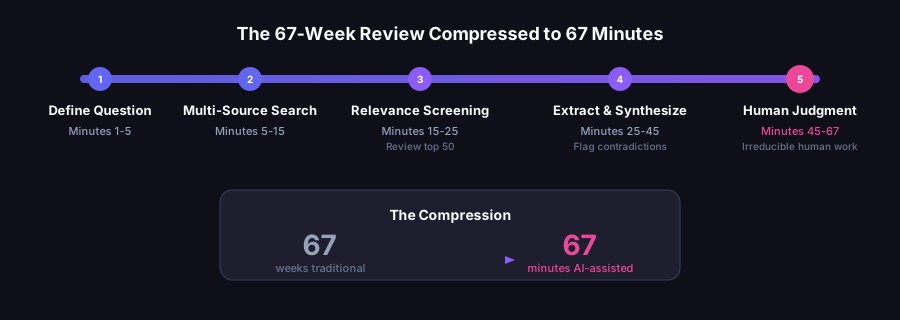
The complete workflow: five phases that compress months of work into just over an hour.
Minutes 1-5: Define the question. Not a keyword string. A research question. "How does remote work affect employee creativity, and does the effect differ by industry?" The specificity matters -- vague questions produce vague results.
Minutes 5-15: Multi-source search. A multi-agent research system hits academic databases, preprint servers, and grey literature simultaneously. Instead of running separate searches on PubMed, SSRN, Google Scholar, and ArXiv, all sources are queried in parallel. The result: 200+ potentially relevant papers surfaced in minutes.
Minutes 15-25: Relevance screening. AI ranks the results by relevance to the specific question, not just keyword match. Papers that directly study remote work and creativity rank higher than papers that mention both terms in passing. The researcher reviews the top 50 ranked results -- a 10-minute scan instead of a 3-week screening phase.
Minutes 25-45: Extraction and synthesis. For each relevant paper, AI extracts: sample size, methodology, key findings, limitations, and how the paper relates to the broader question. It flags contradictions ("Study A found positive effects; Study B found negative effects -- but Study A used self-report measures while Study B used behavioral observation") and identifies gaps ("No studies examined this in healthcare or manufacturing").
Minutes 45-67: Human review and judgment. The researcher reads the AI synthesis, checks key claims against source papers, adds analytical perspective, identifies the argument, and shapes the narrative. This is the irreducible human work -- and it's where the researcher's expertise actually matters.
The result isn't a finished systematic review ready for peer review. It's a comprehensive landscape of the literature that would have taken months to compile manually. The researcher can then decide: which papers need deep reading, where the interesting tensions are, and what the review's contribution will be.
Where AI Literature Review Goes Wrong
The speed is real. The risks are also real.
Citation hallucination. AI tools can generate references that look legitimate -- correct journal name, plausible author names, realistic title -- but don't exist. A Columbia Journalism Review study found that AI search tools answer incorrectly more than 60% of the time when asked to identify specific sources. In a literature review, a fabricated citation can undermine the entire work.
Recency bias. Most AI tools are better at finding recent papers than historical ones. A review that misses foundational work from the 1990s because the AI prioritized 2024 publications is structurally incomplete.
Database coverage gaps. Not all AI research tools access all databases equally. Paywalled journals, conference proceedings, dissertations, and non-English publications may be underrepresented. A review that only covers what the AI can access isn't systematic -- it's convenient.
Synthesis without understanding. AI can identify that two studies have contradictory findings. It cannot always explain why. Methodological nuance -- the difference between a cross-sectional survey and a longitudinal cohort study, or why a p-value of 0.049 in a study with 12 participants means something different than p=0.001 in a study with 12,000 -- requires domain expertise that current AI tools lack.
The Practical Framework for Using an AI Literature Review Tool Safely
If you're using AI for literature review, here's the approach that balances speed with rigor.
Use AI for discovery, not citation. Let AI find the papers. Read them yourself before citing them. Every reference in your review should be a paper you've at least skimmed with your own eyes. If you need a stricter verification flow, start with our guide on how to verify AI research.
Verify the key papers exist. For the 10-15 papers that form the backbone of your review, check that they exist in the actual database (PubMed, DOI lookup), that the authors and findings match what the AI reported, and that you've read the abstract at minimum. This is exactly where the broader AI research citation accuracy problem shows up.
Use AI synthesis as a first draft, not a final product. The pattern identification is valuable -- "these five studies all found X, while these three found Y" -- but the analytical interpretation needs to be yours.
Document your AI-assisted process. Methodological transparency matters. If you used AI tools to screen papers, say so. If your initial search was AI-generated, describe how you validated the results. The academic community is still establishing norms here, and transparency protects your credibility.
Don't skip the backwards and forwards citation check. AI finds papers that match your query. It may miss papers that are critically relevant but use different terminology. Check the reference lists of your key papers (backwards) and see who has cited them since (forwards). This step catches what keyword-based search -- human or AI -- misses, especially in the kinds of credibility gaps we see in deep research outputs.
Who This Is For
Graduate students starting a dissertation literature review. The traditional approach takes a semester of full-time work. AI compression reduces the discovery and screening phases from months to days, leaving more time for the analytical work that actually develops expertise.
Research teams conducting rapid evidence reviews for policy or clinical decisions. When a health department needs to know "what does the evidence say about X intervention" in weeks rather than years, AI-assisted review is the only viable path.
Interdisciplinary researchers working across fields. A computer scientist studying the ethics of facial recognition needs papers from CS, law, philosophy, sociology, and policy. No human researcher reads fluently across all these literatures. AI search across domains surfaces connections that siloed database searching misses.
R&D teams evaluating prior art or competitive landscapes. The question isn't academic rigor -- it's whether relevant work exists, who's doing it, and what the findings suggest for your own direction.
AI Literature Review Tool FAQ
What is the best AI literature review tool for academic research?
The best AI literature review tool for academic research is the one that helps you search broadly, screen quickly, and verify citations easily. In practice, that means using AI for discovery and synthesis, then manually checking the backbone papers before you cite them.
Can AI do a systematic literature review by itself?
No. AI can accelerate search, abstract screening, and first-pass synthesis, but a publishable systematic review still needs human judgment for inclusion criteria, database coverage, reproducibility, and citation verification.
How accurate are AI literature review citations?
Not accurate enough to trust blindly. Citation quality varies by tool and topic, which is why the safest workflow is to let AI surface candidate papers, then verify the key references in the original databases and PDFs yourself.
When should you not use an AI literature review tool?
Do not rely on an AI literature review tool by itself when you need PRISMA-grade rigor, exact legal or medical citations, or a final argument that depends on fine methodological nuance. Those are the moments when human review matters most.
Sources and further reading
- BMC guide on systematic review timelines
- Beller et al. on search-to-publication lag in medical reviews
- Columbia Journalism Review / Tow Center benchmark on AI search citation accuracy
- How to verify AI research output
- The AI research citation accuracy problem
- Deep research credibility problem
The Real Shift
The bottleneck in knowledge work has never been access to information. It's been synthesis. The ability to take 100 papers and extract the signal -- what do we actually know, where do the studies disagree, and what hasn't been studied yet.
AI doesn't replace the researcher who can answer those questions. It eliminates the months of mechanical work that stand between the question and the analysis. The 67-week review becomes a 67-minute foundation that the researcher builds on with judgment, expertise, and original thinking.
The literature review isn't dying. The part that was always tedious and error-prone is being automated. The part that was always valuable -- the human interpretation -- becomes more important, not less.
Rabbit Hole searches academic databases, preprint servers, and grey literature simultaneously with multiple AI research agents. Get a synthesis with citations and confidence scores, not a chat response. Try it free on Rush.
Related Articles
The 2026 Buyer's Guide to AI-Powered Research Assistants
The best ai-powered research assistant in 2026 depends on whether you need a fast answer, a literature workflow, or a report you can actually defend after the meeting.

ChatGPT Deep Research vs Perplexity vs Rabbit Hole: Which One Cites Sources That Actually Exist?
If a deep research tool gives you a polished paragraph with one dead link or one unsupported claim, the report is already compromised. Here is the citation test that matters.
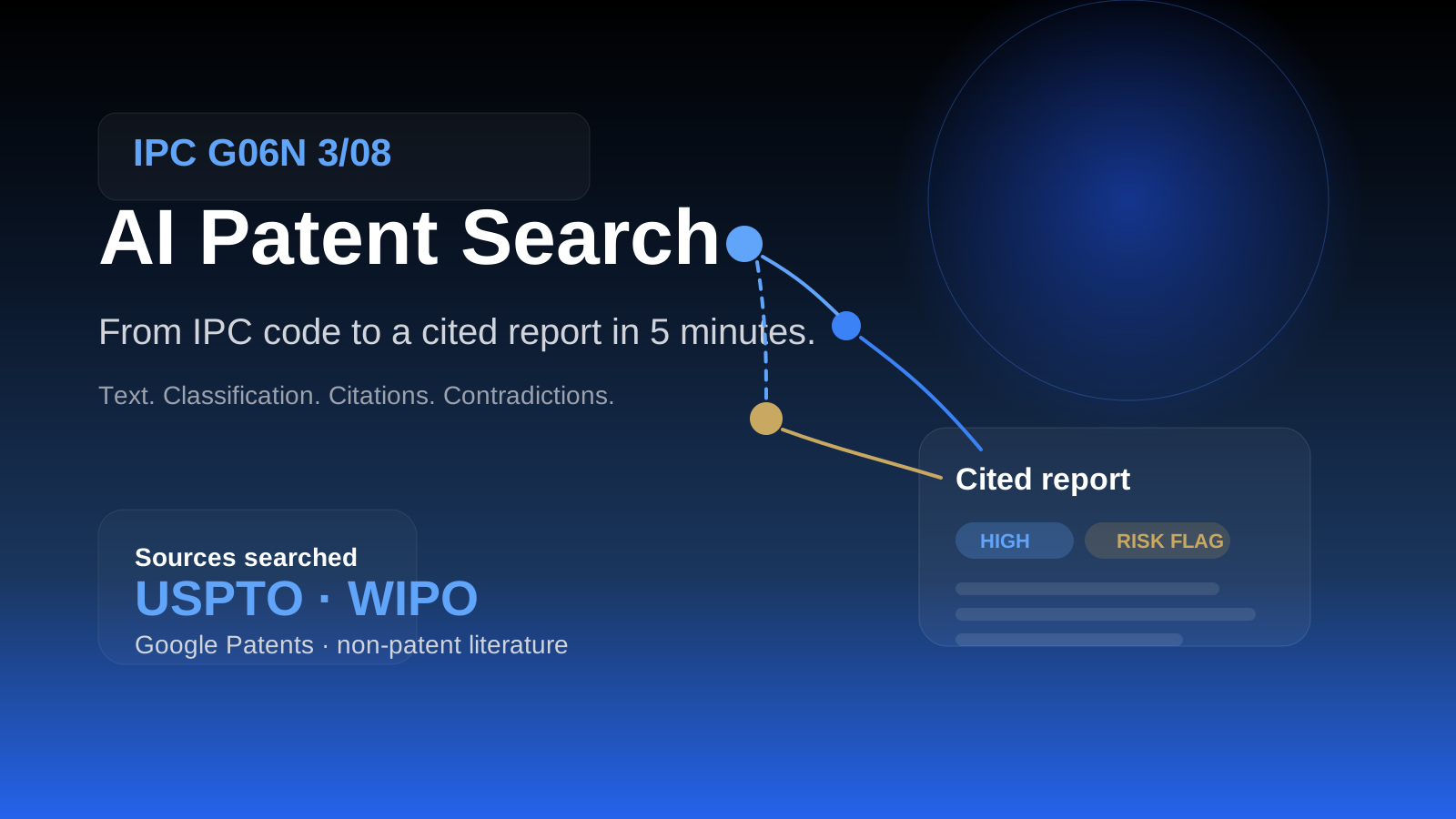
AI Patent Search: From IPC Code to Cited Report in 5 Minutes
Patent search is not one query. It is text, classification, citations, and non-patent literature across multiple databases. Here is the workflow that gets you from an IPC code to a cited report faster without pretending verification is optional.
Ready to try honest research?
Rabbit Hole shows you different perspectives, not false synthesis. See confidence ratings for every finding.
 Try free