

ChatGPT Deep Research Review (2026): When It Works and the Best Alternative for High-Stakes Research
ChatGPT deep research is great for fast first-pass briefs, but weak source hierarchy and confidence handling still matter. Here's when it works and the best alternative.
ChatGPT deep research is one of the most important AI product launches of the last year because it trained users to expect more than a one-paragraph chatbot answer. You can hand it a real question, wait a few minutes, and get back something that looks much closer to analyst work than autocomplete.
That shift matters. It also creates a new failure mode: polished research that feels trustworthy before it has actually earned trust.
OpenAI's own launch post says deep research can "find, analyze, and synthesize hundreds of online sources" and produce a report in tens of minutes, but the company also explicitly warns that it can still hallucinate facts, make incorrect inferences, struggle to distinguish authoritative information from rumors, and fail to communicate uncertainty well. Those are not edge cases for research work. Those are the job. OpenAI deep research announcement
So if you're evaluating ChatGPT deep research in 2026, the right question is not "is it amazing?" It is "for which research jobs is it good enough, and where does it quietly become dangerous?"
2-minute answer: Use ChatGPT deep research for fast synthesis, not final truth. If the output will influence diligence, legal, scientific, or board-facing decisions, switch to a workflow that makes source hierarchy and uncertainty explicit.
- Best for: market scans, meeting briefs, first-pass synthesis
- Weakest for: due diligence, legal review, technical claims that need line-by-line defense
- Main risk: polished prose can hide weak or conflicting evidence
- Best next read if you need a verification workflow: How to Verify AI Research Output. If you are considering Perplexity but need deeper research capabilities, see our guide to the best Perplexity alternative for deep research.
Jump to the comparison table · Jump to when to switch · Jump to the practical workflow
Quick verdict: when ChatGPT deep research works vs when it doesn't
Use ChatGPT deep research when you need a fast first-pass briefing, a market map, or a synthesis draft that a human expert will still review. Use a ChatGPT deep research alternative when source hierarchy, contradiction handling, or claim-by-claim defensibility actually matter.
This is a practical fit matrix based on the source-sensitivity described in this guide, not an external benchmark.
ChatGPT deep research vs Rabbit Hole vs Perplexity
| Criteria | ChatGPT Deep Research | Rabbit Hole | Perplexity |
|---|---|---|---|
| Best for | Fast first-pass synthesis | High-stakes defensible research | Quick answer retrieval |
| Research depth | Strong summary layer | Stronger evidence layering | Light |
| Source separation | Limited | Explicit by source type and specialist agent | Limited |
| Confidence signaling | Inconsistent | More legible confidence framing | Inconsistent |
| Best output | Draft briefing | Structured report with evidence layers | Fast answer |
| Risk if facts must be defensible | Medium to high | Lower | High |
If you only need a fast answer, Perplexity is often enough. If you need a polished first-pass memo, ChatGPT deep research is often enough. If you need research you can defend after the meeting, Rabbit Hole is the stronger fit.
When ChatGPT deep research is enough vs when to switch to an alternative
| Situation | Best choice | Why |
|---|---|---|
| Need a meeting brief by 3 PM | ChatGPT Deep Research | Fast synthesis beats manual tab juggling |
| Need a quick market map before strategy work | ChatGPT Deep Research | Good at turning a fuzzy question into a first-pass frame |
| Need fast web answers and a few citations | Perplexity | Lighter, faster retrieval workflow |
| Need due diligence, board-facing, or client-facing defensibility | Rabbit Hole | Source hierarchy and contradiction handling matter more than speed |
| Need a report that separates evidence types and flags uncertainty | Rabbit Hole | Better fit for explicit confidence framing |
Five questions to ask before you trust a ChatGPT deep research report
| Question | If the answer is "no" | What to do next |
|---|---|---|
| Can I tell which sources are primary versus commentary? | You may be reading a smooth synthesis built on weak evidence. | Re-check the core claims against primary documents, filings, or original studies. |
| Does the report show disagreement between sources? | The model may be smoothing over the most important conflict. | Compare the most material claims in a second system or manual search pass. |
| Can I quickly verify the 5 most important claims? | The citations may look credible without being defensible. | Run a manual spot check or use a workflow built for verification. |
| Is the cost of being wrong low? | A polished answer may still be unsafe to act on. | Treat the output as draft context, not a final recommendation. |
| Would I forward this report unchanged to a client, board, or partner? | If not, you already know it needs more evidence discipline. | Use a source-separated workflow like AI due diligence or a more auditable AI research assistant. |
This is the practical filter. If you cannot answer those questions cleanly, ChatGPT deep research is still useful, but only as a compression layer before verification.
What ChatGPT deep research actually does well
The breakthrough is not that ChatGPT can browse the web. Plenty of tools do that. The breakthrough is that deep research can hold a goal for longer than a normal chat session, follow a multi-step path, synthesize what it finds, and return a structured report instead of a stream of partial answers.
That makes it genuinely useful for four kinds of work.
ChatGPT deep research is good for landscape mapping
If you are trying to understand a market, technology, regulation, or product category quickly, ChatGPT deep research is strong at turning a fuzzy question into a first-pass map.
Ask a question like "What are the main categories of AI compliance tooling for healthcare teams?" and it will usually come back with a workable frame: vendors, common workflows, pricing patterns, regulatory constraints, and open questions. That saves hours of tab-opening and note consolidation.
This is where the tool feels magical. It compresses the exploratory phase of research, which is usually the messiest and most time-consuming part.
ChatGPT deep research is good for synthesis-heavy briefings
If your bottleneck is turning many links into one readable memo, deep research is often good enough. It can collect scattered material, summarize it, and organize it into sections quickly.
That is useful for:
- internal briefings before meetings
- early market scans
- feature comparisons
- travel, vendor, or purchase research
- fast context gathering before a strategy session
OpenAI positions the feature exactly this way: a system for complex, multi-step internet research that can act more like an analyst than a chat interface. OpenAI deep research announcement
ChatGPT deep research is good when speed matters more than auditability
Sometimes the question is not "what is perfectly true?" It is "what do we know well enough by 3 PM to move forward?"
For that use case, deep research is excellent. It gives teams a fast working draft of reality. If the stakes are moderate and the report will still be reviewed by a human who knows the domain, the time savings are real.
Where ChatGPT deep research breaks
The problem with ChatGPT deep research is not that it always fails. The problem is that it fails in ways that look finished.
A weak Google result looks weak. A messy notebook full of links looks incomplete. A beautifully formatted AI report with headings, citations, and calm prose looks credible even when the source handling is thin. That presentation layer is what makes deep research powerful. It is also what makes it risky.
ChatGPT deep research still inherits the citation problem
The broader AI search ecosystem still has a serious source-attribution problem. In March 2025, Columbia Journalism Review's Tow Center tested eight generative search tools and found that they collectively answered more than 60 percent of article-identification queries incorrectly. The issue was not just factual error. The issue was confident factual error. Their writeup notes that these systems often preferred being wrong over admitting uncertainty. CJR / Tow Center study
That study was not a direct benchmark of ChatGPT deep research mode specifically. But it does describe the ambient environment these systems operate in: models that are much better at producing authoritative-looking answers than at signaling when retrieval failed.
OpenAI itself acknowledges this in the product announcement. Deep research, according to OpenAI, may hallucinate facts, make incorrect inferences, and show weakness in confidence calibration. OpenAI deep research announcement
If your job depends on being able to defend the exact source behind a claim, that matters more than how polished the output looks.
ChatGPT deep research is weaker when the source hierarchy matters
Some research tasks are not just about finding information. They are about weighting information correctly.
A company blog post, a regulator filing, a peer-reviewed paper, a community forum thread, and a vendor landing page are not interchangeable evidence. A useful research tool has to treat them differently.
This is where a lot of AI research outputs still flatten reality. They produce synthesis before they produce source discipline. You get a smooth answer built from uneven evidence.
That is especially risky in:
- legal and compliance research
- due diligence
- scientific or medical review
- competitive intelligence
- security or privacy analysis
On HN today, practical security and reliability threads still dominated over vague AI hype. That matches the real decision buyers are making here: not whether the output is impressive, but whether it stays trustworthy when scrutiny increases.
ChatGPT deep research can blur confidence and completeness
A long report feels comprehensive. It often isn't.
Research quality is not just a function of word count or number of citations. It depends on whether the system found the important dissenting evidence, whether it noticed what was missing, and whether it made the uncertainty visible.
Many teams confuse "the model found a lot" with "the research is complete." Those are not the same thing.
If you have ever read a deep research report and thought, "This sounds right, but I can't tell which sentence I should trust the most," you have already felt the real limitation.
When ChatGPT deep research is enough
Use ChatGPT deep research when:
- you need a fast first pass, not a final answer
- the report will be reviewed by someone who knows the domain
- you want synthesis more than raw evidence management
- the cost of a missed source is annoying, not catastrophic
- your real bottleneck is time
This is why the product has real staying power. For many users, this is enough. A faster, better first draft of the research process is still a meaningful upgrade over normal browsing.
When you need a ChatGPT deep research alternative
You need a ChatGPT deep research alternative when the work product has to survive scrutiny after the meeting, not just during it.
That usually means one or more of these conditions are true:
- you need to separate academic, technical, social, and company sources instead of blending them
- you need explicit confidence on claims, not just citations at the bottom
- you need exportable artifacts like structured tables and reports
- you need the system to surface disagreement, not smooth it over
- you need research that can plug into due diligence, strategy, or product decisions
Rabbit Hole is built for that kind of work. Instead of running one broad synthesis pass, it uses multiple specialist agents in parallel so the report can separate source types, preserve contradictions, and make uncertainty visible. That matters when you're evaluating a market, comparing competitors, or trying to verify whether a claim survives contact with the underlying evidence.
If you are comparing tools directly, start with Best AI Research Assistants for 2026. If your bigger concern is whether polished outputs are creating false confidence, read Deep Research Tools Look Credible. That's the Problem.. If your real workflow is board-facing, client-facing, or investment-facing, the adjacent operating model is AI due diligence, where source hierarchy matters more than output fluency. If your work is academic rather than commercial, the sharper adjacent workflow is an AI literature review tool that compresses screening without pretending citation verification is optional.
The practical workflow that actually works
The best way to use ChatGPT deep research is not to treat it as an oracle. Treat it as a compression engine.
Here is the workflow that holds up:
- Use ChatGPT deep research to map the space quickly.
- Pull out the 5-10 claims that actually matter.
- Verify those claims against primary or highest-authority sources.
- Re-run the question in a system that emphasizes source separation and confidence if the stakes are high.
- Turn the verified findings into the final memo, deck, or recommendation.
This sounds slower than trusting the first report. It is slower. It is also much cheaper than making a confident mistake.
If you want the reusable version of that process, save How to Verify AI Research Output. If the research is heading toward an investment, partnership, or vendor decision, use the stricter AI due diligence frame instead of a generic synthesis pass.
FAQ: ChatGPT deep research in 2026
What is ChatGPT deep research?
ChatGPT deep research is OpenAI's longer-running research mode that browses, synthesizes, and returns a structured report instead of a quick chat answer. It is designed for multi-step internet research, not just one-shot prompting.
Is ChatGPT deep research accurate?
It can be useful, but accuracy depends heavily on the task. For first-pass synthesis it can be strong, but both OpenAI's own cautions and broader AI-search testing show that citation quality, inference quality, and uncertainty signaling still need human review.
What is the best ChatGPT deep research alternative?
The best alternative depends on the job. For quick answer retrieval, Perplexity is often enough. For high-stakes research where source hierarchy, contradictions, and defensibility matter, Rabbit Hole is the stronger fit.
Is ChatGPT deep research good for due diligence?
It is fine for an initial scan, but weak as a final diligence layer. Due diligence needs evidence weighting, explicit uncertainty, and defensible sourcing, which is where specialized research workflows matter more than polished prose.
How is Rabbit Hole different from ChatGPT deep research?
Rabbit Hole is built around multiple specialist agents, source separation, and reusable research artifacts. The core difference is not just more text output. It is making the evidence structure and confidence legible enough for humans to act on.
Should you use ChatGPT deep research in 2026?
Yes, with the right mental model.
ChatGPT deep research is real progress. It is one of the first mainstream tools that made users feel the difference between chat and actual research workflow. It deserves the attention it got.
But it is not the end state. It is the beginning of a new category where the winning product will not just summarize more pages. It will make evidence quality, uncertainty, and conflicting signals legible enough for humans to act on.
If you want a fast synthesis engine, ChatGPT deep research is a good tool.
If you want research you can defend line by line, you need more than a polished report. You need a system built around verification.
Rabbit Hole is a research assistant for high-stakes work. It uses multiple specialist agents in parallel to produce structured reports with citations, confidence ratings, and reusable artifacts.
Related Articles
The 2026 Buyer's Guide to AI-Powered Research Assistants
The best ai-powered research assistant in 2026 depends on whether you need a fast answer, a literature workflow, or a report you can actually defend after the meeting.

ChatGPT Deep Research vs Perplexity vs Rabbit Hole: Which One Cites Sources That Actually Exist?
If a deep research tool gives you a polished paragraph with one dead link or one unsupported claim, the report is already compromised. Here is the citation test that matters.
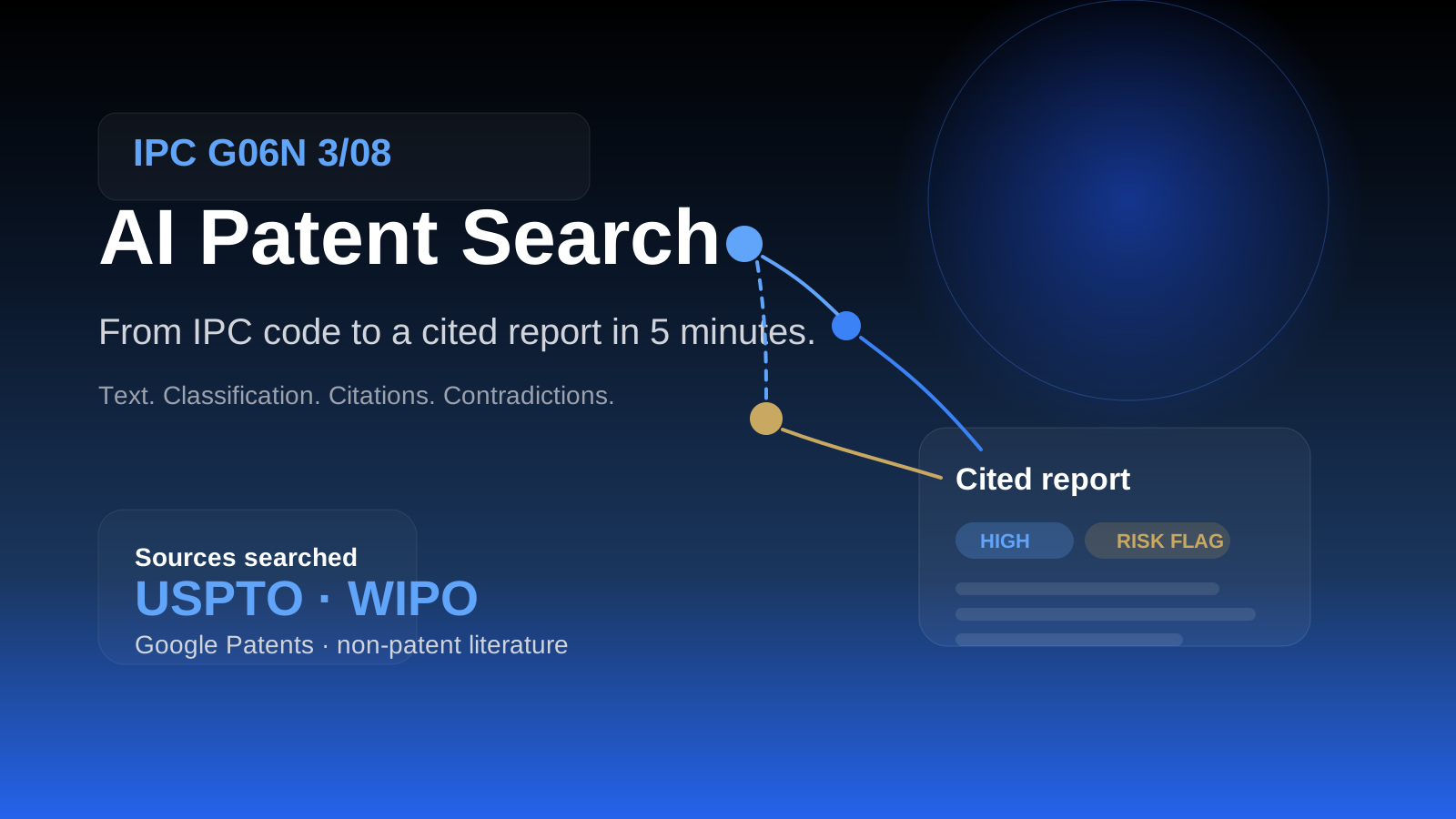
AI Patent Search: From IPC Code to Cited Report in 5 Minutes
Patent search is not one query. It is text, classification, citations, and non-patent literature across multiple databases. Here is the workflow that gets you from an IPC code to a cited report faster without pretending verification is optional.
Ready to try honest research?
Rabbit Hole shows you different perspectives, not false synthesis. See confidence ratings for every finding.
 Try free