

Perplexity Alternative: Why Researchers Switch to Multi-Agent Research for Deep Analysis
The best perplexity alternative depends on whether you need fast answers or defensible research. Here's when to switch and what changes in your workflow.
If you are looking for a Perplexity alternative, you have already experienced what Perplexity does well—and where it stops. It is the fastest way to get a sourced answer to a straightforward question. But when your research shapes decisions that matter, speed becomes less valuable than confidence.
The difference: Perplexity retrieves and summarizes sources for quick answers. Rabbit Hole conducts multi-agent research that synthesizes conflicting evidence, rates confidence per claim, and produces auditable artifacts you can defend in a memo or meeting.
- Choose Perplexity when the question has a clear answer and you need it in under a minute.
- Choose Rabbit Hole when the question requires comparing competing claims, assessing source quality, and shipping something you can stand behind.
This is not a product review. It is a workflow guide for researchers who have outgrown fast answers and need to understand what changes—and what improves—when you switch from search-style retrieval to multi-agent research.
Jump to the comparison · Jump to when to switch · Try Rabbit Hole free
What Perplexity does well
Perplexity built its reputation on one promise: ask a question, get an answer with sources, fast. That promise holds for many research tasks.
Where Perplexity excels:
- Quick factual retrieval. "What is the market cap of Company X?" or "When did Regulation Y take effect?"
- Initial exploration. Getting oriented on a topic you know nothing about.
- Source surfacing. Finding relevant papers, articles, or documents faster than traditional search.
- Follow-up refinement. Narrowing a broad question through successive queries.
The interface is clean, the citations are visible, and the latency is low. For questions where there is a correct answer and finding it quickly matters, Perplexity is hard to beat.
Where Perplexity hits limits
The same design choices that make Perplexity fast create constraints when research gets complex.
The flattening problem. Perplexity synthesizes sources into a unified answer. This works when sources agree. When they conflict, the synthesis can blend contradictions into a coherent-sounding but potentially misleading conclusion without flagging the disagreement prominently.
No confidence calibration. Perplexity does not tell you how certain it is about individual claims. A speculative interpretation and a well-established fact receive similar presentation. In high-stakes research, this ambiguity is costly.
Limited structure for complex outputs. Perplexity produces answers in a chat format. For diligence reports, literature reviews, or competitive analysis, you often need structured sections, executive summaries, methodology notes, and appendices—formats that require significant manual reorganization.
Single-context limitations. Complex research often requires maintaining multiple threads: tracking a competitor's product evolution while simultaneously monitoring their financial trajectory and leadership changes. Perplexity handles one query context at a time.
Perplexity excels at retrieval but is not designed for synthesis that must survive scrutiny under questioning.
Perplexity vs Rabbit Hole: what changes
When you switch from Perplexity to Rabbit Hole as your primary research workflow, several things change—not just in output, but in how you think about research quality.
| Aspect | Perplexity | Rabbit Hole | What changes |
|---|---|---|---|
| Primary output | Sourced answer | Structured research report | You ship documents, not chat transcripts |
| Source handling | Surface and cite | Triangulate and rate confidence | You know which claims are solid vs speculative |
| Conflicting evidence | Synthesized into one narrative | Flagged, analyzed, presented with dissent | Contradictions become visible, not smoothed over |
| Research depth | Single-query breadth | Multi-agent parallel exploration | Multiple angles investigated simultaneously |
| Artifacts | Chat history | Downloadable reports with sections | You get reusable assets for memos and decks |
| Confidence signals | None explicit | Per-claim confidence ratings | You can defend or qualify claims appropriately |
| Time investment | Seconds to minutes | Minutes to tens of minutes | Higher upfront cost, lower verification cost later |
The trade-off is explicit: Rabbit Hole takes longer because it does more. It does not just retrieve sources—it assesses them, compares them, and surfaces where they disagree. That additional work produces research that requires less manual verification before you can rely on it.
When to switch from Perplexity
You do not need to abandon Perplexity to benefit from Rabbit Hole. The tools serve different stages of the research process.
Keep using Perplexity when:
- You need a quick fact to unblock writing or conversation
- You are orienting yourself on a completely unfamiliar topic
- Speed matters more than verification depth
Switch to Rabbit Hole when:
- The research output will shape a recommendation, investment, or strategy
- Multiple stakeholders will scrutinize the sources and conclusions
- Competing interpretations of the same data exist in your source set
- You need to produce a document with methodology, confidence ratings, and citations
- The cost of being wrong exceeds the cost of being thorough
The workflow that works: both tools, different jobs
Most researchers who switch successfully do not replace Perplexity—they relegate it to the right stage of the process.
Stage 1: Orientation (Perplexity)
- What is this topic about?
- Who are the key players, terms, and debates?
- What should I read first?
Stage 2: Deep research (Rabbit Hole)
- What are the conflicting claims and evidence?
- How confident can I be in each conclusion?
- What report can I defend to stakeholders?
This two-stage approach respects what each tool does well. Perplexity gets you to the starting line faster. Rabbit Hole gets you across the finish line with documentation intact.
What multi-agent research adds
Rabbit Hole is built on a multi-agent architecture that differs fundamentally from single-model retrieval systems.
Multiple specialist agents. Instead of one model handling everything, Rabbit Hole deploys specialized agents for different aspects of research: source discovery, credibility assessment, claim extraction, contradiction detection, and synthesis.
Parallel exploration. While Perplexity processes one query at a time, Rabbit Hole agents explore multiple angles simultaneously—market data, technical documentation, competitor positioning, regulatory filings.
Explicit uncertainty. Where Perplexity presents answers, Rabbit Hole presents answers with confidence signals. You know which claims are well-supported, which are speculative, and where sources disagree.
Structured artifacts. The output is not a chat thread but a structured report with sections, methodology notes, and downloadable formats you can incorporate into your own documents.
Comparison: the same query, different depth
To illustrate the difference, consider a realistic research question: "What is the competitive landscape for AI coding assistants in 2026, and which emerging players pose a threat to incumbents?"
Perplexity approach:
- Retrieves 5-10 recent articles and rankings
- Synthesizes them into a coherent narrative
- Returns a paragraph or two with citations
Rabbit Hole approach:
- Deploys agents to gather market data, funding news, product releases, and user sentiment
- Triangulates claims across multiple source types
- Flags where sources conflict on market share or growth trajectories
- Produces a structured report with executive summary, market map, threat assessment, confidence ratings, and source appendix
Perplexity gives you an answer. Rabbit Hole gives you a document you can defend.
Pricing and access
| Plan | Perplexity | Rabbit Hole |
|---|---|---|
| Free tier | Unlimited basic queries, some model limits | 3 reports, full feature access |
| Basic/Paid | Pro at $20/month | Basic at $29/month (10 reports) |
| Higher tier | — | Plus at $79/month (unlimited) |
Perplexity is cheaper for casual use. Rabbit Hole is priced for professional research workflows where the output has downstream value.
Making the switch
If you are ready to try Rabbit Hole as a Perplexity alternative:
- Start with a real question you are already researching—not a test query, but something you actually need answered
- Compare outputs directly—run the same question through both tools and see what differs in structure, citation density, and confidence signaling
- Use the artifact—download the Rabbit Hole report and try incorporating it into your actual workflow (memo, deck, recommendation)
- Check the verification burden—note how much additional work you need to do before trusting each output
Your first Rabbit Hole report will take longer than a Perplexity query. That is by design. The time trade-off only makes sense if the output needs to survive scrutiny. For those cases, the extra time buys confidence you cannot get from fast synthesis.
Related reading
- Best AI Research Assistants for 2026 — Broader comparison including ChatGPT Deep Research
- ChatGPT Deep Research Review — When OpenAI's synthesis tool works and when it does not
- How to Verify AI Research Output — A workflow for checking any AI-generated research
- AI Search: The Confidently Wrong Problem — Why citation does not equal verification
- The Deep Research Credibility Problem — Why polished reports can hide weak sources
Bottom line: Perplexity is a search tool that answers questions. Rabbit Hole is a research system that produces defensible reports. The right Perplexity alternative depends entirely on whether your research needs to survive a second look.
Related Articles

The 2026 Buyer's Guide to AI-Powered Research Assistants
The best ai-powered research assistant in 2026 depends on whether you need a fast answer, a literature workflow, or a report you can actually defend after the meeting.

ChatGPT Deep Research vs Perplexity vs Rabbit Hole: Which One Cites Sources That Actually Exist?
If a deep research tool gives you a polished paragraph with one dead link or one unsupported claim, the report is already compromised. Here is the citation test that matters.
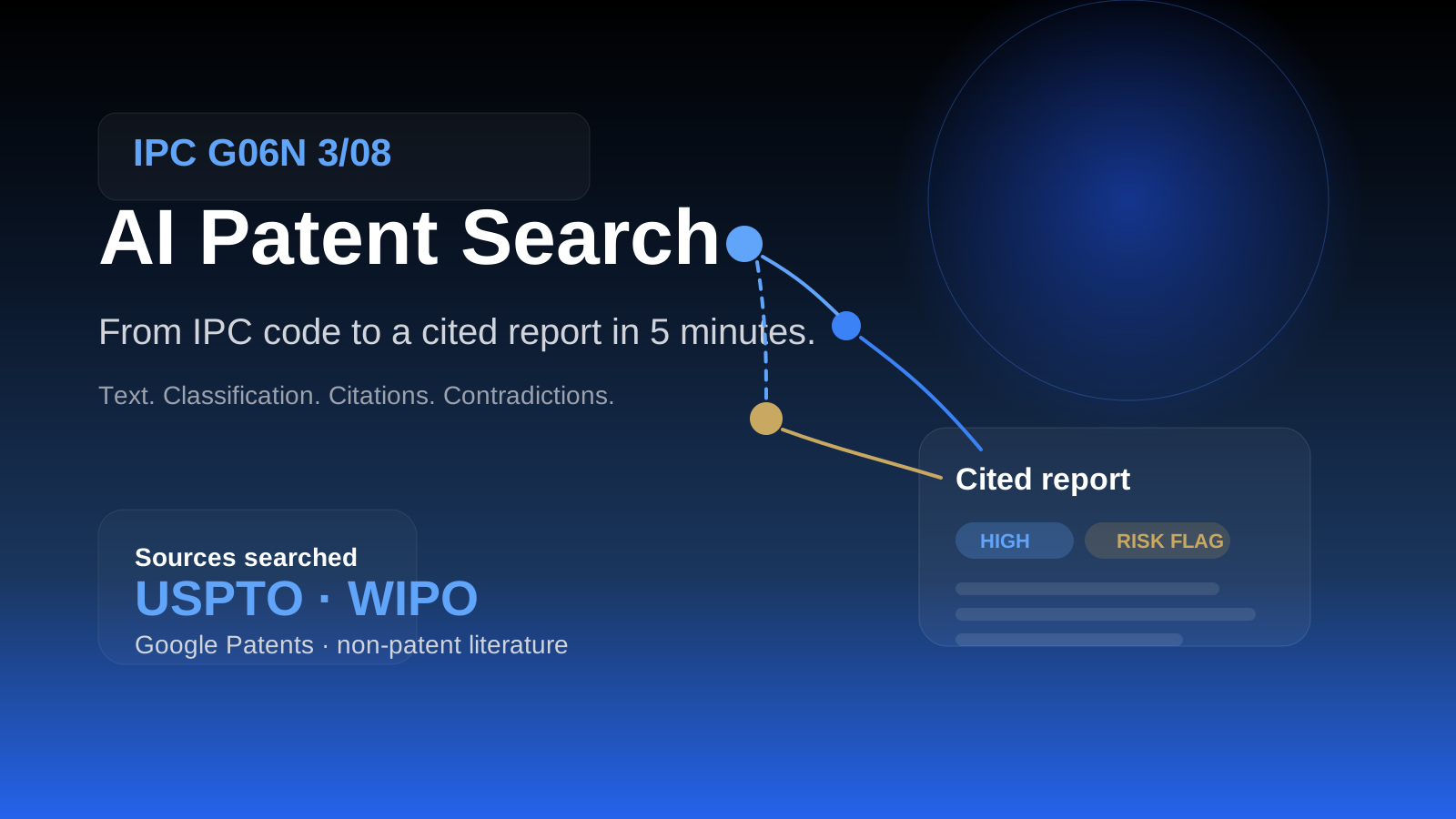
AI Patent Search: From IPC Code to Cited Report in 5 Minutes
Patent search is not one query. It is text, classification, citations, and non-patent literature across multiple databases. Here is the workflow that gets you from an IPC code to a cited report faster without pretending verification is optional.
Ready to try honest research?
Rabbit Hole shows you different perspectives, not false synthesis. See confidence ratings for every finding.
 Try free