AI Research Assistant for Teams: Fixing the Collective Intelligence Gap
An AI research assistant should compound team knowledge, not trap it in silos. Here's how to fix the collective intelligence gap in 2026.
If you are evaluating an AI research assistant for a real team, the first question is not whether it writes well. It is whether the system helps one researcher build on what another already learned. Most do not.
Every AI agent you've used has amnesia. Not the kind where it forgets your name. ChatGPT and Claude increasingly remember facts about you. The deeper problem is team memory: when five people research the same topic, each person's AI learns nothing from the others. Your partner documents a client's preferences; your AI remains oblivious. A colleague discovers a critical insight; your agent starts from zero.
This is why so many so-called AI research assistant products still feel like expensive notepads. The gap is architectural, not cosmetic: knowledge stays trapped in isolated sessions instead of compounding across the team.
Quick answer: what an AI research assistant for teams should actually do
If you want the short version: an AI research assistant for teams should connect prior work, surface relevant internal context at the start of a new thread, and preserve privacy without forcing every researcher to start from zero. If it only stores separate chat histories, it is not giving you collective intelligence. It is giving you nicer fragmentation.
The $800/Month Notepad Problem
Andrei Deiu, who has been building and using AI agents for two years, recently published a viral analysis that crystallized what many research teams have felt but couldn't articulate. After burning through OpenClaw, LangChain stacks, and every "personal AI" that launched on Product Hunt, he identified three structural failures that nobody is fixing. The first is devastating in its simplicity: every agent has amnesia, and memory is siloed.
"When a family shares a household or a team collaborates on a project, none of that knowledge connects," Deiu writes. "Five people can tell the same AI about the same project and it learns nothing from the overlap. There is no compounding, no collective intelligence, no network effect."
Think about how knowledge actually works in a research team. When someone documents a decision, everyone benefits. When a teammate learns something about a market, the whole team gets smarter. When a researcher finds a gap in the literature, subsequent researchers should build on that discovery rather than redundantly covering the same ground.
AI agents, as currently architected, don't work this way. They're individual notepads pretending to be collective intelligence.
ChatGPT's memory is per-user by design. Claude's project context resets between sessions. OpenClaw stores flat Markdown files in isolated directories. None of them build connected knowledge across users. Each researcher starts alone, stays alone, and reinvents the same wheels.
Why AI Research Assistant Workflows Break in Teams
The implications for research productivity are severe. Consider a typical enterprise research scenario:
Sarah on the strategy team spends three hours researching competitive positioning for a new market entry. She documents her findings in a report. Three weeks later, Michael from product development asks his AI assistant the same foundational questions. The AI has no awareness of Sarah's work. Michael repeats the research, wasting three more hours and potentially reaching different conclusions due to different sources.
This isn't hypothetical. A March 2026 analysis of AI agent limitations found that knowledge workers burn $30 to $800 monthly on AI API calls, with much of that spending going toward redundant research that colleagues have already completed. The kicker: there's no visibility into where the money goes or which conversations duplicate existing work.
The problem compounds with team size. A five-person research team might have 15 overlapping research threads happening simultaneously, each isolated in individual AI sessions. The team's collective intelligence—the sum of their discoveries, insights, and synthesized knowledge—never forms. Instead, you have five smart people using expensive notepads.
The Architecture of Isolation
Why did we end up here? The answer lies in how AI systems were originally designed.
Consumer AI products like ChatGPT and Claude were built for individual use cases. Their memory systems optimize for personalization—learning your preferences, your writing style, your context. This works brilliantly for individual productivity but creates a fundamental mismatch for collaborative research.
Enterprise AI platforms haven't solved it either. Most "team" features amount to shared chat histories or document repositories—knowledge storage, not knowledge integration. The AI doesn't understand relationships between facts contributed by different users. It doesn't form connections between Sarah's competitive analysis and Michael's product research. It certainly doesn't surface relevant prior work when you start a new research thread.
OpenClaw attempted to address this with a file-based memory system, but as Deiu notes, it stores "flat Markdown files in a directory." The recent Snyk security audit finding that 13% of ClawHub skills contain critical security issues further complicates adoption for research teams handling sensitive competitive intelligence.
The result: research teams are paying premium prices for AI tools that deliver individual assistance while actively preventing the emergence of organizational knowledge graphs.
What an AI Research Assistant With Collective Intelligence Would Actually Look Like
The solution isn't more storage or better chat interfaces. It's a fundamental architectural shift from per-user memory to shared knowledge graphs.
Imagine a research system where:
- Every research session enriches a shared knowledge structure
- Facts connect to other facts, regardless of who contributed them
- Preferences link to patterns; patterns reveal insights
- Private research stays private, but shared discoveries compound
- The more the team researches, the richer the collective knowledge becomes
Deiu describes this vision: "A shared knowledge graph where every user enriches the same structure. Facts connect to preferences, preferences connect to patterns. Private sessions stay private, but shared knowledge compounds across everyone who contributes."
In practice, this would transform research workflows:
When Sarah completes her competitive analysis, her key findings—market size estimates, competitor positioning maps, identified gaps—enter the shared knowledge graph as structured entities. Three weeks later, when Michael asks his research agent about market entry strategy, the agent doesn't start from scratch. It recognizes the connection to Sarah's prior work and surfaces her competitive analysis as foundational context.
The agent might say: "Sarah from strategy researched this market three weeks ago. She identified three primary competitors and noted a positioning gap in the mid-market segment. Would you like me to build on her analysis or explore a different angle?"
This isn't science fiction. Knowledge graph architectures have existed for decades. What's missing is integration with modern AI agents in a way that preserves privacy while enabling collective intelligence.
The Research Productivity Multiplier
The economic case for collective intelligence in research is compelling.
Consider a mid-size research team of 10 knowledge workers. If each person spends 15 hours per week on research (conservative for strategy, product, and consulting roles), that's 150 research hours weekly. Industry estimates suggest 20-30% of research time is spent on redundant or overlapping work—rediscovering what colleagues already know, verifying facts already documented, chasing dead ends already identified.
At a loaded cost of $100/hour, that's $3,000 to $4,500 weekly in redundant research effort. Annually: $156,000 to $234,000 in wasted productivity for a 10-person team.
Collective intelligence doesn't eliminate all redundancy—some overlap is healthy for validation and fresh perspectives. But reducing redundant research by even 50% while improving research quality through better context would deliver $75,000+ in annual value for a mid-size team.
The multiplier effect goes beyond time savings. When research compounds—when each person's work builds on the team's collective knowledge—the quality of insights improves. Patterns emerge that no individual would spot. Connections form between disparate research threads. The team's output becomes greater than the sum of its parts.
Why 2026 Is the Inflection Point
Several converging factors make collective intelligence for research a 2026 imperative:
First, the cost problem has reached a tipping point. AI agent users report burning $30 to $800 monthly in API costs with minimal visibility into what drives those costs. When research is siloed, those costs scale linearly with team size. Collective intelligence creates economies of scale—shared research reduces per-user costs while improving output quality.
Second, the "change fitness" era has arrived. Harvard Business School's Tsedal Neeley argues that 2026 is when "change fitness"—the capacity to metabolize significant and ongoing change—becomes the AI differentiator. Research teams that build collective intelligence systems now will have sustainable competitive advantages as AI capabilities accelerate. Those stuck in individual notepad mode will fall further behind.
Third, the technology has matured. Knowledge graphs, vector databases, and AI orchestration have evolved from experimental to production-ready. The technical barriers to building collective intelligence have fallen while the economic case has strengthened.
Fourth, early adopters are proving the model. Teams running shared knowledge graph architectures report compounding benefits: 340+ knowledge nodes and 500+ relationship edges forming within 30 days of multi-user deployment. The agents begin inferring preferences users never explicitly stated, connecting insights across research threads that no single user contributed.
The Path Forward for AI Research Assistant Teams
If your research workflow currently involves individual AI assistants with isolated memory, you're not behind—you're typical. But the gap between "impressive demo" and "reliable production system" is closing, and teams that solve the collective intelligence problem first will pull ahead.
This is also why tool choice matters more than people admit. If you're evaluating which systems can actually support research teams, compare the trade-offs in Best AI Research Assistants for 2026 and sanity-check outputs with How to Verify AI Research Output.
Here's a practical roadmap:
Audit your current redundancy. For one week, have team members tag research sessions that felt redundant or that rediscovered existing knowledge. Calculate the time cost. The number will be sobering and motivating.
Identify your knowledge anchors. What research does your team repeatedly reference? Competitive landscapes, customer segments, regulatory frameworks, technical architectures? These are candidates for shared knowledge structures.
Pilot structured knowledge sharing. Before implementing new technology, test the workflow. Have researchers document key findings in a shared format with explicit connections to related work. Even this manual step reveals the potential value of automated collective intelligence.
Evaluate collective intelligence tools. Look for systems that offer shared knowledge graphs with privacy controls, not just shared storage. The key differentiator: does the system understand relationships between facts, or merely archive documents?
Measure compounding. Track metrics that reflect collective intelligence: time to research background for new projects (should decrease), cross-referencing of prior research (should increase), unique insights per research hour (should improve as the knowledge base enriches).
The Bottom Line
AI research agents promised to augment human intelligence at scale. Instead, they've largely automated individual notetaking while preserving the knowledge silos that have plagued organizations for decades.
The good news: this is a solvable problem. The technology exists. The economic case is clear. The teams that figure out collective intelligence in 2026 will operate at a different velocity than those still managing isolated AI notepads.
The question isn't whether collective intelligence will become standard for research teams. It's whether your team will be among the early adopters who capture the compounding benefits, or the late majority who spend 2027 catching up.
Your AI research agent doesn't have to feel like a notepad. But getting from here to there requires recognizing that the current architecture isn't a temporary limitation—it's a fundamental design choice that most platforms aren't motivated to change. The solutions exist. The only question is whether your team will implement them before your competitors do.
Rabbit Hole is a research agent built on a shared knowledge graph architecture. Every research session enriches your team's collective intelligence while keeping private work private. Learn more about how Rabbit Hole transforms research workflows.
Related Articles
The 2026 Buyer's Guide to AI-Powered Research Assistants
The best ai-powered research assistant in 2026 depends on whether you need a fast answer, a literature workflow, or a report you can actually defend after the meeting.

ChatGPT Deep Research vs Perplexity vs Rabbit Hole: Which One Cites Sources That Actually Exist?
If a deep research tool gives you a polished paragraph with one dead link or one unsupported claim, the report is already compromised. Here is the citation test that matters.
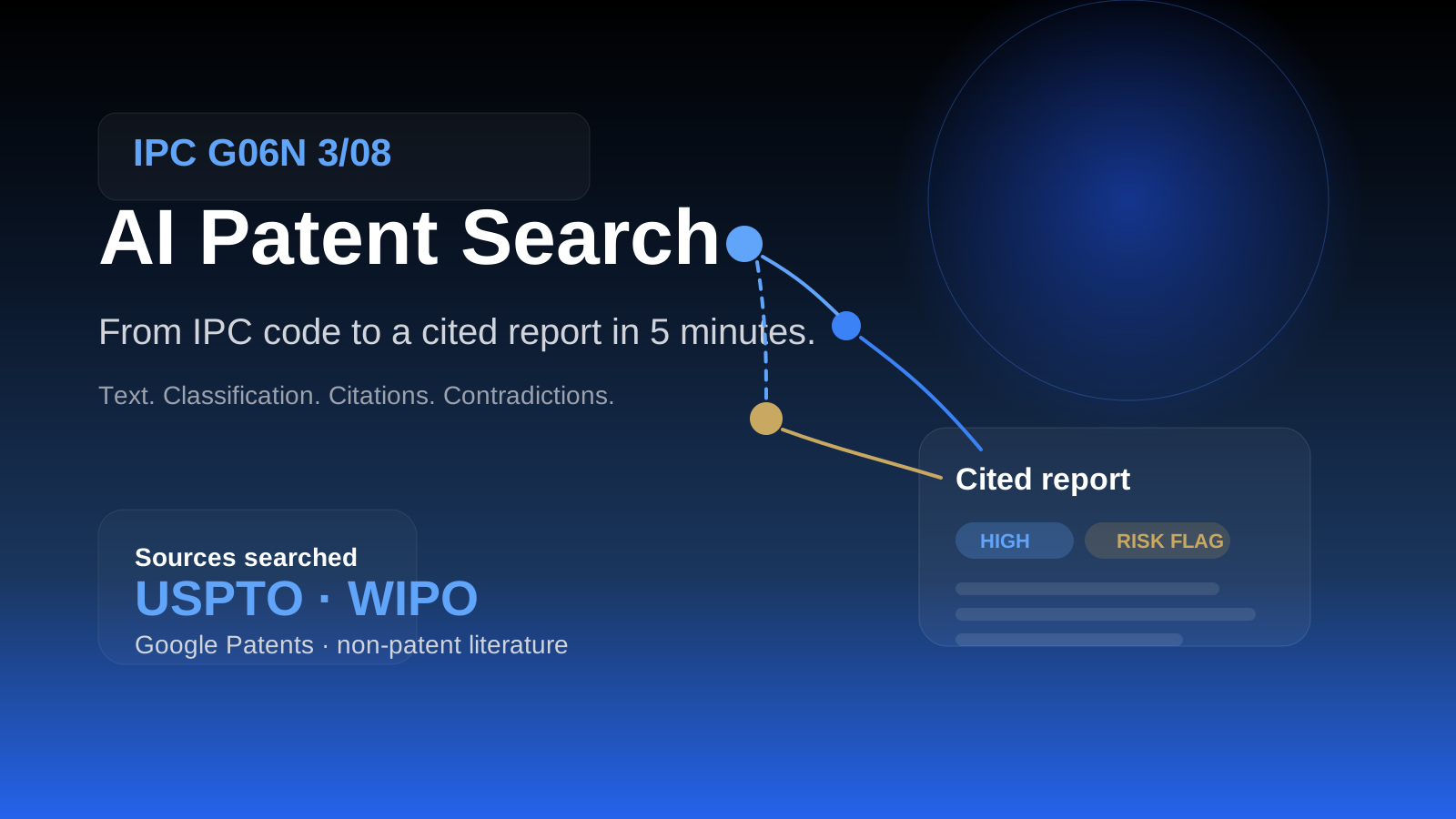
AI Patent Search: From IPC Code to Cited Report in 5 Minutes
Patent search is not one query. It is text, classification, citations, and non-patent literature across multiple databases. Here is the workflow that gets you from an IPC code to a cited report faster without pretending verification is optional.
Ready to try honest research?
Rabbit Hole shows you different perspectives, not false synthesis. See confidence ratings for every finding.
 Try free