
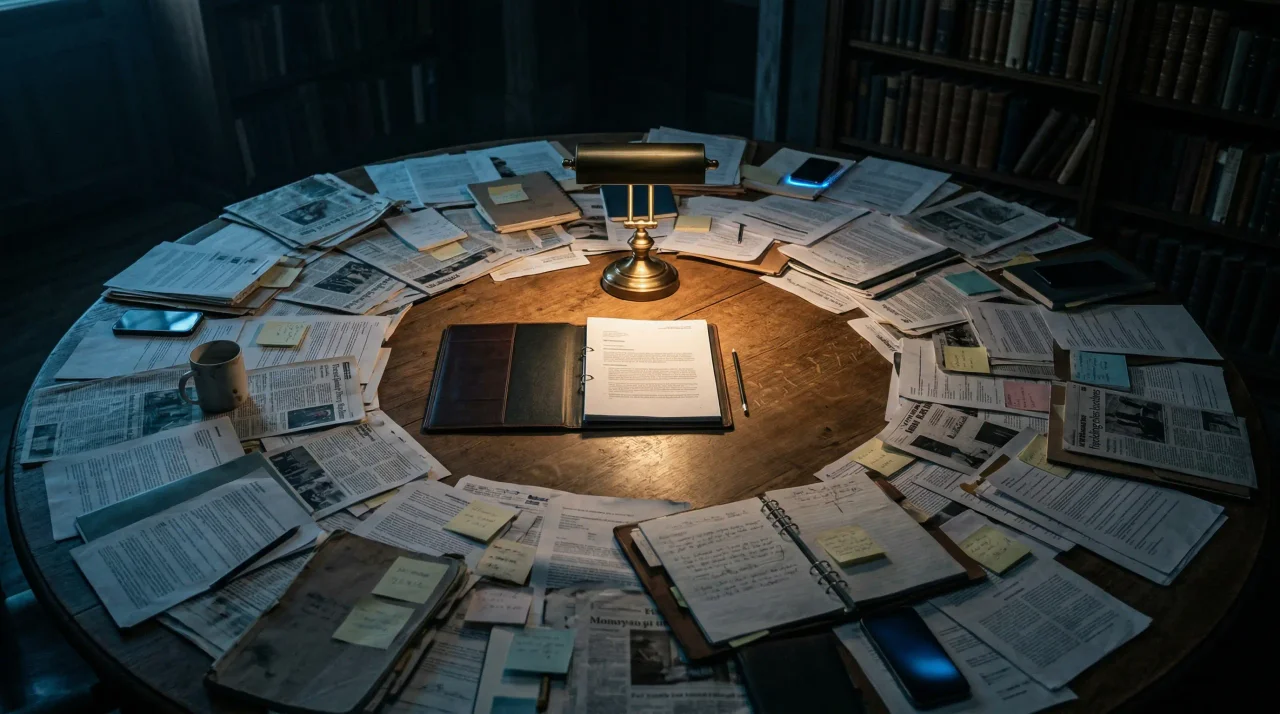
Stop Opening 47 Tabs
Research used to mean drowning in browser tabs. Rabbit Hole does the drowning for you — and surfaces with actual answers.
You know the feeling. You need to understand something — a competitor, a market, a technology — so you open a tab. Then another. Then you're twenty tabs deep and you've forgotten what the original question was.
Three hours later you have 47 tabs open, a headache, and no clear answer. You've read fragments of Wikipedia, skimmed three Hacker News threads, glanced at a paywalled academic paper, and watched a YouTube explainer that turned out to be wrong. Your browser is a crime scene. Your brain is mush.
This is how research works now. Not because it has to, but because we never built anything better.
The Research Tax
Every knowledge worker pays this tax. Consultants writing investment memos. Grad students doing literature reviews. Founders sizing markets. Journalists fact-checking. The pattern is identical: scatter across the internet, collect fragments, try to assemble them into something coherent.
The hidden cost of tab-based research isn't just time—it's the cognitive exhaustion that comes before you even start analyzing.
The cost isn't just time. It's cognitive load. Each tab is a context switch. Each source demands evaluation: Is this credible? Is it current? Does it contradict what I just read? By the time you've gathered enough fragments to form a view, you're too tired to trust your own judgment.
ChatGPT promised to fix this. And it helped — for simple questions. But ask it something nuanced and you get confident-sounding summaries with no sources. It's like hiring a research assistant who reads fast but never tells you where they got their information. Useful for orientation. Useless for decisions.
Deep Research tools are better. They actually search. But they're still single-threaded: one agent, one sequential search, one wall of text output. You get an answer, but not a report you can share. Not citations you can verify. Not confidence ratings that tell you which findings are solid and which are speculative.
What Real Research Looks Like
Real research — the kind that holds up in a partner meeting or a thesis defense — has structure.
It pulls from multiple source types: academic papers for rigor, practitioner forums for ground truth, financial filings for data, news for context. It evaluates source quality explicitly. It notes contradictions instead of smoothing them over. It produces something you can use: a report with citations, comparison tables, visual summaries.
The bottleneck isn't finding information—it's synthesizing 47 fragments into one coherent picture without losing your mind in the process.
Most importantly, it knows what it doesn't know. Real research surfaces uncertainty. It flags the difference between "this is established" and "this is what one person claimed on Reddit."
Building this by hand takes days. The tools we have either automate the gathering (but skip the rigor) or enforce the rigor (but require manual assembly). Nothing does both.
Six Specialists, One Question
Rabbit Hole approaches research the way a good research team would: divide and conquer.
When you ask a question, six specialist agents fan out in parallel. An academic researcher searches papers and citations. A community researcher scans Reddit and Hacker News for practitioner sentiment. A technical researcher digs into code and architecture. A product researcher maps the competitive landscape. A finance researcher pulls filings and quotes. A visual researcher generates diagrams — timelines, comparisons, hierarchies — to make the findings comprehensible.
Each specialist goes deep in their domain. They don't just search; they evaluate. Academic sources get weighted differently than forum posts. Contradictions get flagged, not hidden. Low-confidence findings get labeled as such.
Then a report-writer synthesizes everything into a structured document: executive summary at the top, detailed findings below, citations inline, confidence ratings explicit. You get a PDF you can share, a markdown file you can edit, a BibTeX export for your thesis.
The whole thing takes two to three minutes. What used to consume a day now happens while you get coffee.
The Difference Is Delegation
ChatGPT Deep Research is impressive. But it's one agent doing sequential search. It can't simultaneously check arXiv, scan Reddit sentiment, analyze SEC filings, and generate comparison diagrams. The parallelism matters — not just for speed, but for coverage. Different sources reveal different facets. Missing any facet means missing part of the truth.
The output matters too. Deep Research gives you a chat message. Rabbit Hole gives you a report: structured, cited, exportable. Something you can put in front of a client or a committee without apologizing for the format.
And the confidence ratings change how you use the research. When you see "High confidence" next to a finding, you know it's backed by peer-reviewed sources or official filings. When you see "Low confidence," you know you're looking at early signals or single-source claims. This transparency lets you make calibrated decisions. You can bet big on high-confidence findings and investigate low-confidence ones further.
What It's For
Investment memos. A consultant needs to evaluate a Series A company: team backgrounds, competitive positioning, market size, risk factors. Rabbit Hole produces a full memo with competitor grid and red flags — in the time it used to take to schedule the first expert call. See how consultants are replacing their research workflow.
Literature reviews. A grad student needs to survey 20+ papers on their thesis topic, organized by methodology, with actual citations. What used to take a week of library time now takes a morning. Here's the complete AI literature review workflow.
Competitive analysis. A founder needs to understand how their competitor positions, what customers complain about, where the product gaps are. The community researcher surfaces sentiment the competitor's marketing team hopes you never see. Learn how to do competitive intelligence without a spy budget.
Due diligence. A VC needs background on a founder before Monday's partner meeting. Funding history, team red flags, customer concentration — the kind of mosaic you can't get from a single source. See the VC research workflow that fits between discovery and the partner meeting.
The End of Tab Hoarding
Research isn't going away. The need to understand complex topics, evaluate claims, and make informed decisions is permanent. What's changing is how we do it.
We've accepted the 47-tab method because it was the only method. But it's not actually research — it's digital foraging. Gathering scraps and hoping they assemble into insight.
Real research requires structure: multiple sources, parallel investigation, explicit evaluation, clear synthesis. Until now, that structure required human labor — days of work for every question.
Multi-agent systems collapse that labor. Six specialists working in parallel produce what one generalist can't: comprehensive, evaluated, structured research. Not a wall of chat text. A report you can act on.
The 47-tab browser is a symptom of inadequate tools. When the tools improve, the symptom disappears. You ask a question. You get an answer. The tabs never open.
This is what comes after search engines. Not better search — better research.
Related: How to research any topic without drowning in tabs · The credibility problem with AI research tools · Why your AI research assistant isn't delivering
Related Articles

The 2026 Buyer's Guide to AI-Powered Research Assistants
The best ai-powered research assistant in 2026 depends on whether you need a fast answer, a literature workflow, or a report you can actually defend after the meeting.

ChatGPT Deep Research vs Perplexity vs Rabbit Hole: Which One Cites Sources That Actually Exist?
If a deep research tool gives you a polished paragraph with one dead link or one unsupported claim, the report is already compromised. Here is the citation test that matters.
AI Patent Search: From IPC Code to Cited Report in 5 Minutes
Patent search is not one query. It is text, classification, citations, and non-patent literature across multiple databases. Here is the workflow that gets you from an IPC code to a cited report faster without pretending verification is optional.
Ready to try honest research?
Rabbit Hole shows you different perspectives, not false synthesis. See confidence ratings for every finding.
 Try free